Is the thought of a devastating data breach keeping you up at night? For many Canadian business owners, navigating the world of cybersecurity services feels like a complex maze of technical jargon and ever-changing threats. You know you need to protect your business, your data, and your customers, but you may not have the time or in-house expertise to manage it all. This constant worry can be overwhelming, pulling your focus away from what you do best: running your business.
It’s time to end that stress, finally and forever. This guide was created to demystify cybersecurity in plain, simple English. We’ll break down exactly what services are essential for a business your size, explain the real threats you face, and provide a clear, actionable plan to improve your security. You’ll learn how to choose a trustworthy local partner to handle it all, giving you the peace of mind to focus on your customers, knowing your business is protected.
Key Takeaways
- Understand why Canadian small and midsize businesses are prime targets for cyberattacks and why proactive defense is a necessity, not a luxury.
- Learn to decode the different types of cybersecurity services-from proactive monitoring to employee training-and match them to your specific business needs without the geek-speak.
- Follow a straightforward 3-step framework to assess your unique risks and build a practical, effective security strategy for your business.
- Discover the critical questions you must ask when choosing a local partner in Toronto to ensure you get the right protection and support.
Why Cybersecurity Services Are a Necessity, Not a Luxury
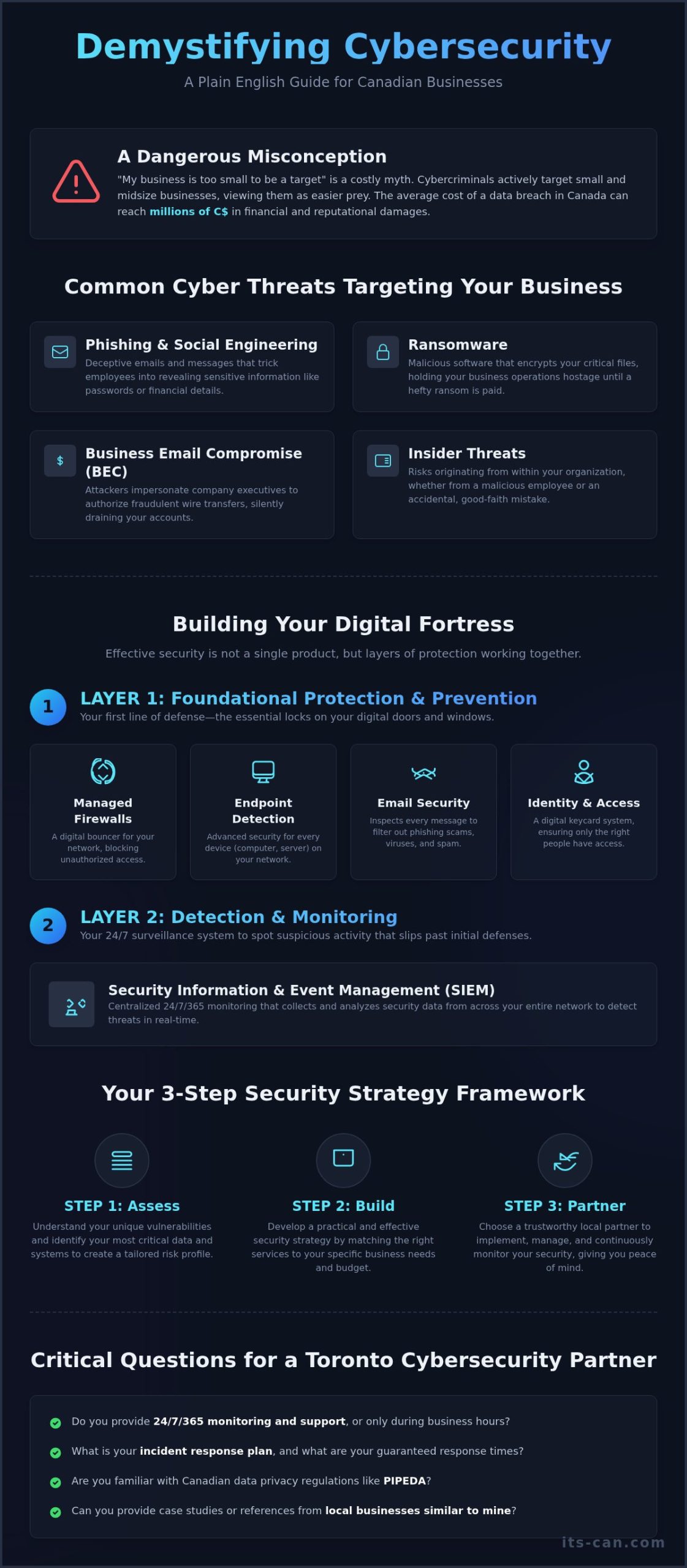
As a Canadian business owner, your focus is on growth and serving your customers, not on the complex digital threats lurking online. But have you ever thought, “My business is too small to be a target”? This is a dangerous and costly misconception. The reality is that cybercriminals actively target small and midsize businesses, viewing them as easier prey with fewer defences. The consequences can be devastating, with the average cost of a data breach in Canada reaching millions of C$ in financial and reputational damages.
In today’s interconnected world, relying on basic antivirus software is like using a single padlock to protect a fortress. The scope of modern threats is vast, requiring a multi-layered defence strategy. For a comprehensive overview of computer security concepts, it’s clear that a proactive and layered approach is essential. This is where professional cybersecurity services become a critical business investment, providing the peace of mind you need to focus on what matters most.
Common Cyber Threats Targeting Businesses Today
Cybercriminals use a variety of sophisticated methods to infiltrate your network and steal your data. Understanding these common threats is the first step toward protecting your business:
- Phishing & Social Engineering: Deceptive emails and messages designed to trick your employees into revealing sensitive information like passwords or financial details.
- Ransomware: Malicious software that encrypts your critical files, holding your business operations hostage until a hefty ransom is paid.
- Business Email Compromise (BEC): Attackers impersonate company executives to authorize fraudulent wire transfers, silently draining your accounts.
- Insider Threats: Risks originating from within your organization, whether from a disgruntled employee or an accidental, good-faith mistake.
The Limitations of a DIY Approach
Trying to manage cybersecurity in-house often creates more problems than it solves. The digital threat landscape is relentless and requires constant vigilance that most business owners simply cannot provide. A DIY approach often falls short because:
- Threats Don’t Sleep: Attacks can happen at any time, day or night. Effective protection demands 24/7/365 monitoring that is not feasible for most teams.
- Expertise is Required: Security tools are only as good as their configuration. Without specialized knowledge, you risk leaving critical security gaps wide open.
- Criminals Evolve Quickly: New attack methods emerge daily. Keeping up with these changes is a full-time job that distracts you from running your business.
The Core Types of Cybersecurity Services Explained (in Plain English)
Navigating the world of cybersecurity can feel overwhelming, but it doesn’t have to be. The key is to stop thinking about security as a single product and start thinking of it like securing a physical building. You wouldn’t rely on just one lock, would you? Instead, you create layers of protection: prevention (strong locks), detection (alarms), and response (an emergency plan).
The most effective cybersecurity services work together in the same way, building a comprehensive defence that protects your Canadian business from every angle. This multi-layered approach is so critical that government bodies provide detailed guides on Cybersecurity for Small Businesses to help them build a resilient posture. Let’s break down the core services-without the geek-speak.
Foundational Protection & Prevention Services
This is your first line of defence-the essential locks on your digital doors and windows designed to keep threats out from the start.
- Managed Firewalls & Network Security: Think of this as the digital bouncer for your office network, inspecting traffic and blocking unauthorized access before it can cause harm.
- Endpoint Detection & Response (EDR): This is advanced security for every device (computer, server) that connects to your network, acting like a dedicated guard for each potential entry point.
- Email Security & Filtering: Since most attacks start with a fraudulent email, this service acts as your mailroom clerk, inspecting every message to filter out phishing scams, viruses, and spam.
- Identity & Access Management (IAM): This is your digital keycard system, ensuring only the right people have access to the right data and applications, and only when they need it.
Detection & Monitoring Services
You can’t stop every threat at the door. This layer is your 24/7 surveillance system, designed to spot suspicious activity that might have slipped past your initial defences.
- Security Information & Event Management (SIEM): This is your central security control room, collecting and analyzing alerts from all your systems to spot patterns that could indicate an active attack.
- Vulnerability Assessments: A technician proactively inspects your digital “building” for unlocked windows or weak points, giving you a chance to fix them before a burglar finds them.
- Dark Web Monitoring: This service scours the hidden parts of the internet to see if any of your company credentials have been stolen and put up for sale, alerting you immediately.
Response & Remediation Services
When an incident does happen, having a clear plan is the difference between a minor issue and a business-ending catastrophe. These services ensure you’re prepared to act decisively.
- Incident Response Planning: This is your fire drill. A documented, practiced plan that outlines exactly what to do and who to call the moment a breach is detected to minimize damage.
- Penetration Testing (Pen Testing): You hire a team of “ethical hackers” to legally try and break into your systems. Their report shows you precisely where your defences are weakest so you can strengthen them. Learn more about how pen testing services work and whether your business needs them.
- Data Backup & Disaster Recovery: Your ultimate safety net. If your data is ever lost, encrypted by ransomware, or destroyed, this service allows you to restore everything and get back online quickly.
How to Build Your Business’s Security Strategy: A 3-Step Approach
Thinking about cybersecurity can feel overwhelming. Where do you even begin when threats are constantly evolving? The good news is you don’t have to solve everything at once. A strong security posture is built step-by-step, not overnight. This simple, 3-step approach moves you from understanding your unique risks to implementing lasting protection, ensuring every decision is informed and effective.
The goal is to eliminate the guesswork and create a clear, actionable plan. Building a strong defense starts with understanding the fundamentals, a point emphasized in comprehensive resources like the FTC cybersecurity guidance. A reliable partner will guide you through this entire process, translating technical risks into plain English business strategy.
Step 1: The Cybersecurity Risk Assessment
You can’t protect what you don’t know. A professional risk assessment is the critical first step in any security strategy. This isn’t just a technical scan; it’s a thorough review of your entire IT infrastructure, data handling practices, and employee protocols. The result is a clear report that identifies your specific vulnerabilities and provides a prioritized action plan to fix them, starting with the most critical threats first. Start with a professional security assessment.
Step 2: Implementing Foundational Controls
With a clear roadmap from your assessment, the next step is to address the most urgent risks. This involves implementing foundational security controls that provide the biggest impact on your safety. While specific needs vary, this often includes:
- Multi-Factor Authentication (MFA): An essential layer of protection for all accounts.
- Endpoint Detection and Response (EDR): Advanced antivirus that actively hunts for threats on computers and servers.
- Employee Security Training: Turning your team from a potential liability into your first line of defense.
Step 3: Establishing Ongoing Monitoring & Management
Cybersecurity is a continuous process, not a one-time fix. Threats never sleep, and neither should your defenses. This final step involves putting systems in place for 24/7 monitoring to detect and respond to suspicious activity before it can cause costly downtime. This is where managed cybersecurity services provide lasting peace of mind, handling regular system updates, security policy reviews, and constant vigilance so you can focus on running your business.
Choosing the Right Cybersecurity Services Partner in Toronto
Selecting a provider for your company’s cybersecurity is one of the most critical business decisions you will make. Not all providers are created equal, and finding the right fit is crucial for protecting your operations, data, and reputation. You need more than just a tech vendor; you need a trusted partner who understands the unique challenges facing small and medium-sized businesses in the Greater Toronto Area.
A true partner works proactively to secure your business, giving you the peace of mind to focus on your customers. To find a provider who will eliminate your IT frustrations for good, ask these critical questions during your evaluation.
Questions About Their Expertise and Process
A competent provider should be able to prove their skills and communicate clearly. Don’t be afraid to dig into their qualifications and methods.
- Do they hold industry certifications? Look for credentials like CISSP, CISM, or CompTIA Security+ to verify their team’s expertise.
- Can they explain technical concepts in plain English? You should never feel confused or overwhelmed. A great partner avoids “geek-speak” and ensures you understand your security posture.
- Do they provide clear, regular reports? You deserve to know what’s happening with your security. Look for transparent reporting that shows risks, actions taken, and overall system health.
Questions About Their Support and Response
When a security incident occurs, every second counts. Your partner’s availability and location can make all the difference in preventing costly downtime.
- What are their guaranteed response times for critical incidents? Vague promises aren’t enough. Ask for a specific, guaranteed time in your service level agreement (SLA).
- Do they offer 24/7/365 monitoring and support? Cyber threats don’t stick to business hours. Continuous monitoring is essential for proactive threat detection and response.
- Are they based locally in the GTA? A local partner understands the Toronto business landscape and can provide faster on-site support when necessary.
Questions About Their Business Model and Transparency
Your relationship should be built on trust and predictability, especially when it comes to costs. Ensure their business practices align with your needs.
- Do they offer managed cybersecurity services? A predictable, flat-rate monthly fee (in C$) helps you budget effectively and avoids surprise bills after an incident.
- Can they provide client testimonials or case studies? Reputable providers are proud of their work and should have a history of satisfied local clients.
- Is their pricing structure clear and transparent? There should be no hidden fees. All costs should be outlined clearly from the start.
Finding the right team to handle your cybersecurity services is the key to a secure and stress-free future for your business. See why Toronto businesses trust ITS Canada Inc.
Take the Next Step Towards Total Peace of Mind
Navigating the world of digital threats can feel overwhelming, but protecting your business doesn’t have to be. The most critical takeaways are clear: robust security is a core business necessity, not a luxury, and choosing the right local partner is the key to building a resilient defence. Investing in the proper cybersecurity services isn’t just about protecting data-it’s about safeguarding your reputation, ensuring continuity, and empowering future growth.
For businesses across Toronto and the GTA, you don’t have to face these challenges alone. Since 2009, ITS Canada has provided stress-free IT solutions with a guaranteed 5-minute response time and our 100% No-Hassle, ‘No Geek-Speak’ Guarantee. We handle the technology so you can focus on running your business.
Are you ready to solve your security nightmares once and for all? Book a free, no-obligation consultation to discuss your security needs. Take the first step towards a more secure and productive future today.
Frequently Asked Questions About Cybersecurity Services
What is the average cost of cybersecurity services for a small business?
In Canada, the cost for a small business varies based on your size, complexity, and specific needs. Typically, you can expect to invest between C$100 to C$250 per user, per month for a comprehensive managed security plan. While this may seem like a significant expense, it’s a proactive investment in protecting your business from the devastating financial and reputational damage of a data breach, which can cost far more in downtime and recovery.
What is the difference between IT services and cybersecurity services?
In plain English, traditional IT services focus on keeping your technology running efficiently-making sure your computers, network, and software are functional for day-to-day work. Cybersecurity services focus exclusively on protecting that technology from internal and external threats. Think of it this way: IT builds and maintains the house, while cybersecurity installs the locks, alarms, and security cameras to keep intruders out and your assets safe.
Is antivirus software enough to protect my business?
Unfortunately, no. While antivirus is an essential first step, it only protects against known viruses and malware. It cannot defend against modern, sophisticated threats like phishing scams, business email compromise, or advanced ransomware. True protection requires a multi-layered approach that includes firewalls, email filtering, employee security training, and 24/7 monitoring to keep your business secure from every angle and give you real peace of mind.
How often should my business conduct a security assessment?
To stay ahead of constantly evolving cyber threats, we recommend a comprehensive security assessment at least once per year. If your business is in a regulated industry like finance or healthcare, or if you’ve recently made significant changes to your IT infrastructure, conducting an assessment every six months is a wise, proactive step. Regular assessments identify new vulnerabilities before they can be exploited, ensuring your defenses remain strong and reliable.
What is the first step I should take to improve my company’s cybersecurity?
The most critical first step is understanding your current risks. A professional security assessment will analyze your entire network, systems, and policies to identify specific vulnerabilities. This provides a clear, prioritized roadmap for improvement, ensuring you invest your resources in the right areas to fix the most dangerous gaps first. It allows you to stop guessing and start building a truly effective defense to solve your security problems once and for all.
Can my business get cyber insurance, and how do security services affect it?
Yes, Canadian businesses can obtain cyber insurance, and it’s highly recommended. However, insurers now often require you to prove you have robust security measures in place before they will even offer a policy. Partnering with a provider for professional cybersecurity services demonstrates that you are proactively managing risk. This not only makes you eligible for coverage but can also significantly lower your premiums, making your insurance more affordable and effective.