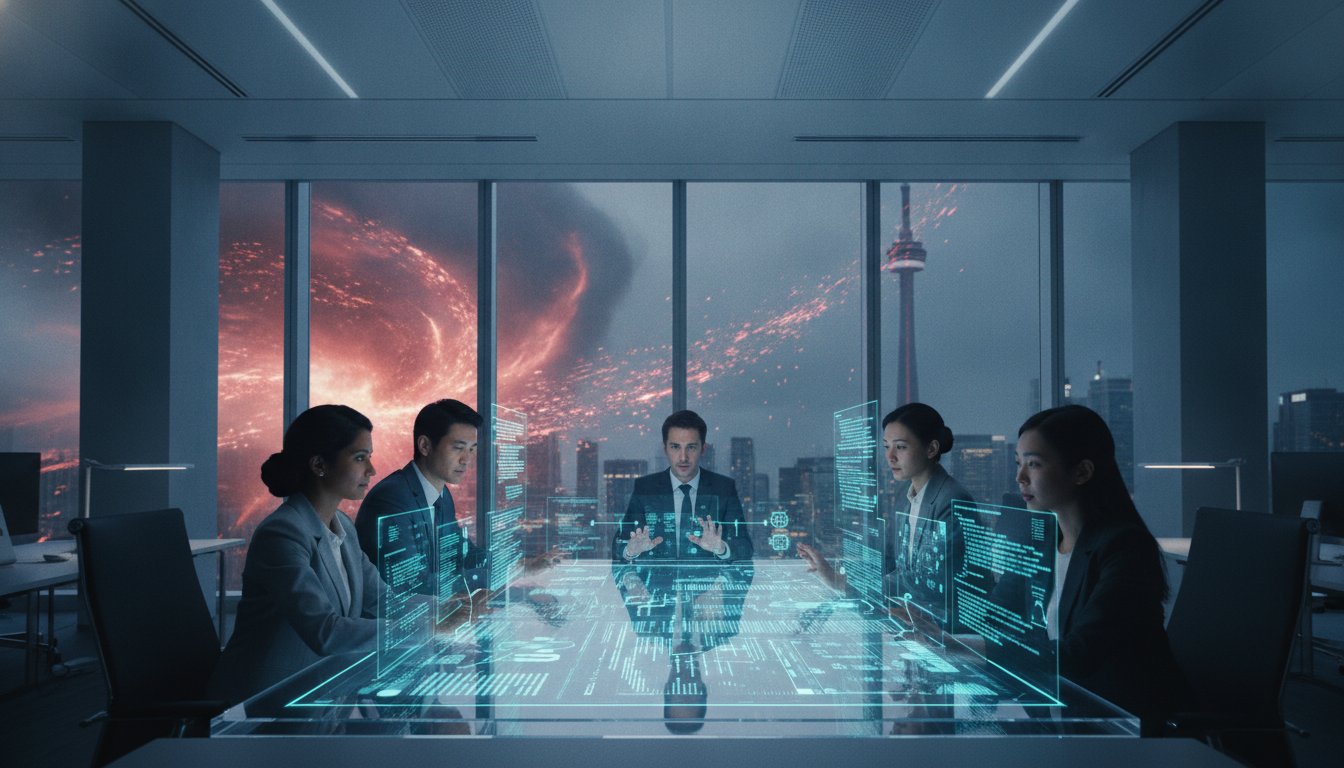
If a ransomware attack locked every workstation in your Toronto office at 9:00 AM on a Monday, would your team know exactly what to do, or would they be hunting for a dusty binder that’s never been opened? It’s a terrifying thought, but it’s the reality for many leaders who rely on “paper-only” strategies. That’s why a disaster simulation for businesses is no longer just a luxury. It’s the only way to prove your survival plan actually works before a real crisis hits. With the average cost of IT downtime now reaching $9,000 per minute, you can’t afford to guess if your backups are truly ready.
We understand the anxiety that comes with technical uncertainty and the frustration of wading through IT jargon. You deserve to feel confident that your business can recover within hours, not days. This article will show you how to validate your business continuity plan through realistic simulations that protect your operations from data loss. We’ll explore the latest trends in operational resilience for 2026 and provide a clear, jargon-free roadmap to ensure your team is ready for anything. It’s time to turn your theoretical plan into a proven shield for your company’s future.
Key Takeaways
- Learn why moving from a static paper plan to active readiness is essential for surviving the high-stakes digital landscape of 2026.
- Discover how a disaster simulation for businesses uses a “crawl, walk, run” approach to build team confidence without overwhelming your daily operations.
- Identify your “Recovery Time Objective” to ensure your business bounces back quickly instead of facing days of paralyzing downtime.
- Get a clear 5-step guide to assembling your simulation team and setting measurable goals that turn technical anxiety into operational resilience.
- See how partnering with experts for Managed IT Services ensures your infrastructure is always “simulation-ready” and capable of recovery within hours.
What is Business Disaster Simulation and Why Does it Matter?
Is your company truly ready for a total digital blackout or a sophisticated ransomware hijacking? In the fast-moving landscape of 2026, having a business continuity plan tucked away in a drawer isn’t enough. A disaster simulation for businesses is a controlled stress test designed to push your operational resilience to the breaking point before a real crisis does. It’s the difference between guessing you’re safe and knowing you can survive. By mimicking real-world threats in a safe environment, you can identify exactly where your systems and people might stumble.
The shift from static, paper-based plans to active readiness is now a business necessity. International standards like ISO 22301 have moved the needle toward continuous maintenance of recovery insights. In Ontario, businesses face a unique cocktail of risks, ranging from regional power grid instabilities to targeted cyberattacks. When the average cost of IT downtime sits at $9,000 per minute, you can’t afford to treat recovery as a theoretical exercise. Investing in a simulation today is a fraction of the cost of an unverified recovery attempt that fails when the clock is ticking.
The Real Cost of “Paper-Only” Plans
Industry data from sources like FEMA suggests that 40% to 60% of small businesses never reopen their doors after a major data loss event. Why is the failure rate so high? Often, it’s because their plans only existed on paper and were never put to the test. When a crisis hits, the psychological impact on staff is immense. If the “proven” plan fails in the first ten minutes, panic sets in, and mistakes multiply.
Simulations also shine a light on “shadow IT.” These are the unauthorized apps or personal devices your team uses to get work done that aren’t included in your official backups. Without testing, these hidden dependencies remain invisible until they cause a total recovery failure. You can learn more about securing these vulnerabilities through our business continuity and disaster recovery services.
Benefits of a “No-Fault” Testing Environment
The primary goal of simulation exercises is to build a culture of calm competence. In a “no-fault” environment, your team can make mistakes, miss steps, and fail without any real-world consequences. This process builds the muscle memory needed to act decisively during a real ransomware event, which cost businesses an average of $1.53 million per incident in 2025.
These exercises help you identify “single points of failure” in your workflow, such as a single staff member who holds the only key to a critical server. By documenting these gaps, you gain the concrete data needed to justify security investments and IT budgets to stakeholders. You move from “hoping for the best” to having a proactive, resilient organization that is ready for anything 2026 throws its way.
Types of Disaster Simulations: From Tabletops to Full-Scale Drills
Not every organization needs to simulate a total city-wide blackout on their first try. The most effective approach for a disaster simulation for businesses follows a “crawl, walk, run” methodology. This allows your team to build confidence and refine protocols without the stress of a full-scale crisis. By starting small, you identify the easy fixes first, ensuring that when you move to more complex scenarios, your foundation is solid. Success depends on choosing a format that matches your current maturity level and involves your key IT partners from the start.
Tabletop Exercises: The Low-Cost Starting Point
A tabletop exercise is a discussion-based session where your leadership team gathers to talk through a specific crisis. There’s no actual downtime, and no systems are turned off. It’s purely about testing your communication and decision-making chains. It’s a great way to find out if your “emergency contact list” is actually up to date. Consider this 15-minute “Ransomware at 8 AM” scenario for your next meeting:
- The Trigger: Your office manager arrives at the Toronto office and finds every computer screen displaying a ransom note.
- The Complication: The local server is encrypted, and the person with the admin passwords is on a flight to Vancouver with no Wi-Fi.
- The Question: Who is the very first person you call? Do you have their number saved on your personal phone, or is it only on the encrypted server?
This simple exercise often reveals that the most basic recovery steps are the ones most likely to fail. If you’re feeling unsure about your team’s initial response, booking a discovery call can help you map out these critical first steps.
Functional Drills and Full-Scale Simulations
Once your team masters the discussion phase, it’s time to move toward functional drills. These are focused tests on specific technical systems. For example, you might attempt to restore a single critical database from a cloud backup to see how long it actually takes. This provides a realistic look at your recovery speed without disrupting the entire company.
Full-scale simulations are the final stage. These involve a total transition to backup systems, often simulating an office closure where everyone must work remotely. While these offer the highest level of readiness, they require careful coordination with your Managed IT provider to prevent actual operational disruption. The goal is to prove your disaster simulation for businesses can be executed smoothly, giving you the peace of mind that your company is truly resilient. By including third-party vendors in these drills, you ensure that every link in your supply chain is ready to support your recovery.
Cybersecurity and IT Stress-Testing: The Core of Modern Resilience
Why are digital threats now the single greatest risk to businesses in the Greater Toronto Area? While physical fires or floods are devastating, a cyberattack can paralyze your entire operation in seconds, regardless of where your staff is located. A disaster simulation for businesses must prioritize these digital vulnerabilities because they are the most likely “disaster” you will face in 2026. The goal is to move beyond theoretical safety and prove your systems can withstand a real-world assault.
One of the most important metrics we test is your Recovery Time Objective, or RTO. In plain English, this is simply the answer to the question: “How long can your business afford to be offline before the damage is permanent?” For some, it’s four hours; for others, it’s four minutes. If your simulation reveals that your recovery takes days, it’s a clear signal that your current infrastructure needs an upgrade. This often leads to a deeper look at your defenses through Penetration Testing, which actively hunts for the backdoors hackers use to bypass your security.
Ransomware Simulations: More Than Just a Firewall
Firewalls are essential, but they are not a silver bullet. With the average cost to recover from a ransomware attack reaching $1.53 million in 2025, a true disaster simulation for businesses must test your “Human Firewall,” which is your staff. How do they react when they receive a high-pressure, fraudulent email during a simulated crisis? We also test your technical recovery. If a total encryption event occurs, can you actually pull your data from off-site, immutable backups? These are copies of your data that cannot be changed or deleted by hackers, providing the ultimate insurance policy against ransom demands.
Validating Your BCDR Strategy
There is a massive difference between a simple file backup and a comprehensive Business Continuity strategy. A backup is just a copy of your files; continuity is the system that keeps your business running while those files are being restored. We define BCDR as the safety net that turns a potential disaster into a minor operational hiccup. Simulations prove that your recovery speed matches your actual business needs, often by leveraging cloud scalability. If your Toronto office is inaccessible, the cloud allows your team to spin up a virtual workspace and stay productive from anywhere.
How to Run a Successful Disaster Simulation: A 5-Step Guide
Running a disaster simulation for businesses doesn’t have to be a chaotic event that disrupts your entire week. It’s a structured, professional process designed to replace anxiety with calm competence. To get the most value, you must move beyond vague goals and establish clear, measurable objectives. Are you testing the speed of your cloud recovery, or are you testing how quickly your HR team can communicate with staff? Knowing exactly what you’re measuring is the only way to turn a drill into a genuine operational strength.
Step 1 & 2: Setting Objectives and Assembling the Team
Success is more than just getting the servers back online. It’s about ensuring you don’t lose customers or permanently damage your reputation during a crisis. This is why the CEO and other department heads must be involved in the simulation. If leadership isn’t at the table, you’re only testing a technical fix, not a business recovery. You also need to assign a “Scribe.” This person’s only job is to document every decision, delay, and point of confusion. Their notes become the “truth” that helps you improve later.
Step 3, 4 & 5: Execution and the Crucial After-Action Report
Every successful drill needs a realistic “inject.” This is the specific event that triggers the disaster. It could be a simulated ransomware note or a sudden failure of your Toronto office’s primary internet line. To truly test your flexibility, introduce complications during the exercise. For example, tell your team that the primary IT manager is “unavailable” and see who steps up. We always recommend conducting these tests in a controlled environment to ensure you never cause actual downtime for your clients.
The final, and most important, step is the After-Action Report. This is where you identify the gap between your written plan and reality. Did the recovery take longer than you promised? Were the instructions too full of technical jargon for the staff to follow? Use these findings to create a strict timeline for fixing the vulnerabilities you discovered. If you’re ready to move from a paper-only plan to a proven survival strategy, you can start by booking a discovery call with our team to evaluate your current readiness.
By following this 5-step guide, you ensure that your disaster simulation for businesses provides actionable data. You’ll walk away with a team that knows their roles and a leadership group that feels confident in their ability to protect the company. It’s about turning a potential catastrophe into a minor, well-managed event.
Partnering for Peace of Mind: How ITS Canada Inc Secures Your Future
Why carry the weight of technical uncertainty alone? You’ve seen the roadmap for a disaster simulation for businesses, but the technical execution shouldn’t rest solely on your shoulders. ITS Canada Inc steps in as your proactive partner to manage the heavy lifting. By leveraging our Managed IT Services, you ensure your infrastructure is simulation-ready from day one. We don’t just help you test for failure; we build systems designed to prevent it. This allows you to focus on your core business growth while we handle the background complexity with calm competence.
Being a local Toronto business ourselves, we understand the specific challenges of the GTA market. Whether it’s a regional power issue or a localized cyber trend, our team is nearby and ready to act. You don’t have to wait for a technician in a different time zone to wake up. ITS Canada Inc provides the expert guidance you need to turn chaotic operational problems into stable, predictable outcomes. Our goal is to move your company from a state of anxiety to one of guaranteed readiness through high-quality service and clear accountability.
Beyond Simulations: 24/7 Proactive Protection
A simulation is a vital test, but our 24/7 proactive monitoring is the daily reality that keeps your business safe. We watch your systems around the clock to catch vulnerabilities before they ever turn into the “injects” we discussed in the previous section. If a staff member clicks a suspicious link or a server begins to flicker, our Help Desk Services act as your first line of defense. We provide immediate support to contain issues before they escalate. ITS Canada Inc is committed to jargon-free communication, ensuring you always have a clear, business-focused understanding of your security posture.
Take the First Step Toward Resilience
Before you run your first full-scale drill, you need to know exactly where you stand. A professional IT audit is the most effective way to uncover hidden risks in your current setup. Since 2009, our Toronto-based team has seen every type of technical hurdle. We use that experience to provide you with a safety net that actually holds. We take personal responsibility for your uptime, providing the peace of mind that your survival plan is a reality, not just a theory.
Don’t wait for a real ransomware event to find out if your backups work. You deserve the confidence that comes with a resilient, well-tested organization. Book a Discovery Call to stress-test your business tech today and let ITS Canada Inc help you build a future where technical disasters are nothing more than a minor, managed event. It’s time to move from uncertainty to a permanent resolution of your technical concerns.
Secure Your Business Legacy with Proven Readiness
Your business represents years of dedication and growth. We’ve seen how a disaster simulation for businesses moves your strategy from a theoretical document to a battle-tested shield. By identifying single points of failure and refining your team’s muscle memory through the steps we’ve discussed, you turn potential chaos into a managed process. This level of readiness ensures that when a crisis hits, your operations remain stable and your reputation stays intact.
Since 2009, ITS Canada Inc has served as a trusted advisor to firms across the GTA, providing expert BCDR management that prioritizes your recovery speed. We stand by our no-jargon guarantee, ensuring that every solution we propose is communicated in plain, accessible language. Our Toronto-based team is committed to taking personal responsibility for your infrastructure, allowing you to focus on leading your company with absolute confidence.
Take the final step toward permanent operational resilience. With the right systems and a dedicated partner by your side, technical disasters become nothing more than minor, manageable events. Your legacy is worth protecting; let’s ensure it’s ready for whatever the future holds.
Frequently Asked Questions
How often should my business run a disaster simulation?
You should conduct a simulation at least once or twice a year, or whenever you make a major change to your IT environment. Regular testing ensures that your staff stays familiar with their roles and that your recovery protocols remain effective against evolving threats. For high-risk sectors in Toronto, quarterly tabletop exercises are often the best way to maintain a culture of constant readiness without disrupting daily work.
Are disaster simulations expensive for small businesses?
Disaster simulations can be scaled to fit any budget, starting with low-cost tabletop discussions that require zero technical spend. While a full-scale drill involves more planning, the investment is a tiny fraction of the cost of actual downtime. Starting with small, focused exercises allows you to identify critical gaps and build your resilience over time without a large upfront expenditure.
What is the difference between a disaster recovery plan and a simulation?
A disaster recovery plan is a written document outlining the steps to take, while a simulation is the active testing of those specific steps. Think of the plan as a blueprint and the simulation as the actual fire drill. Without a disaster simulation for businesses, your recovery plan is just a theory that hasn’t been proven to work when the pressure is on.
Do I need to shut down my office to run a simulation?
No, you don’t need to stop operations because most simulations are conducted in controlled, isolated environments. Tabletop exercises happen in a boardroom with no technical impact, and functional drills focus on specific systems behind the scenes. We design these tests to ensure your daily business continues smoothly while we validate your team’s recovery capabilities.
What is a tabletop exercise in the context of IT security?
A tabletop exercise is a discussion-based session where key stakeholders talk through their response to a hypothetical crisis scenario. It’s a low-stress way to test communication channels and decision-making without touching any live systems. These sessions are perfect for identifying “who does what” and uncovering points of confusion before moving to more technical, hands-on drills.
How long does a typical business disaster simulation take?
A basic tabletop exercise can take as little as two hours, while a full-scale functional drill might last a full business day. The duration depends entirely on the complexity of your systems and the specific goals you want to measure. Most Toronto businesses find that a well-planned four-hour session provides the best balance of depth and operational efficiency.
Can my managed IT provider run these simulations for me?
Yes, a qualified partner should lead these exercises to ensure technical accuracy and provide an objective evaluation of your readiness. Your provider manages the technical work of setting up the test environment and documenting the results. This collaboration allows you to focus on leadership decisions while we verify that the underlying infrastructure is truly resilient.
What are the most common “disasters” businesses in Toronto should simulate?
Ransomware attacks, regional power outages, and sudden hardware failures are the top priorities for local firms. Given the rise in cybercrime, a disaster simulation for businesses should almost always include a data encryption scenario. Simulating a total transition to remote work due to an office closure is also vital for maintaining continuity across the GTA.