Could the very person you hired to lead your operations be losing hours every week playing the role of the “accidental IT person” just to keep your computers running? It’s a common trap for Toronto business owners who feel that keeping technology close to home is the only way to stay in control. When you’re weighing the choice of in-house IT vs managed services, the decision comes down to more than just a headcount. You want a team that prevents problems before they start. Instead, you’re often left dealing with the same frustrating glitches that halt productivity and drive up hidden costs.
We believe you deserve a technology setup that works perfectly every time, without the stress of unpredictable expenses or the looming threat of a cyber incident. This article will reveal the true performance differences between building an internal team and partnering with an expert provider to help you make the smartest investment for your company. You’ll discover how to achieve a permanent resolution to your technical issues while gaining access to expert-level cybersecurity. It’s time to ensure your technology finally serves your business goals instead of hindering them.
Key Takeaways
- Discover the true cost of hiring a Toronto IT professional, including the hidden overhead of benefits, taxes, and ongoing training.
- Understand how professional documentation and transparency can actually give you more control over your company data than a single internal hire.
- Compare the performance and security benchmarks of in-house IT vs managed services to see which model best supports your 2026 growth goals.
- Explore the co-managed model to see how an external partner can support your existing team with specialized cybersecurity and maintenance.
- Identify the specific criteria your business needs to achieve a permanent resolution to technical issues and move toward predictable monthly spending.
Understanding the IT Dilemma: In-House IT vs. Managed Services
Are you the person everyone turns to when the internet goes down or a printer stops responding? Many Toronto business owners find themselves trapped in the role of the “accidental IT person.” This usually happens when a company grows faster than its technical support can keep up. You end up juggling high-level client meetings and low-level server resets. It is a frustrating cycle that halts productivity and creates unnecessary stress. You didn’t start your business to be a technician; you started it to lead and grow.
The debate over in-house IT vs managed services is really about how you want to spend your time and your budget. In-house IT involves hiring a dedicated employee or a small team to remain on your payroll. Managed IT services involve partnering with an external firm of specialists who handle everything from cybersecurity to daily support. In 2026, this choice has become a vital strategic decision. With the June 2026 passage of the Critical Cyber Systems Protection Act (CCSPA) and significant updates to Ontario privacy laws, the legal and operational stakes for data security have never been higher.
The Role of the Internal IT Employee
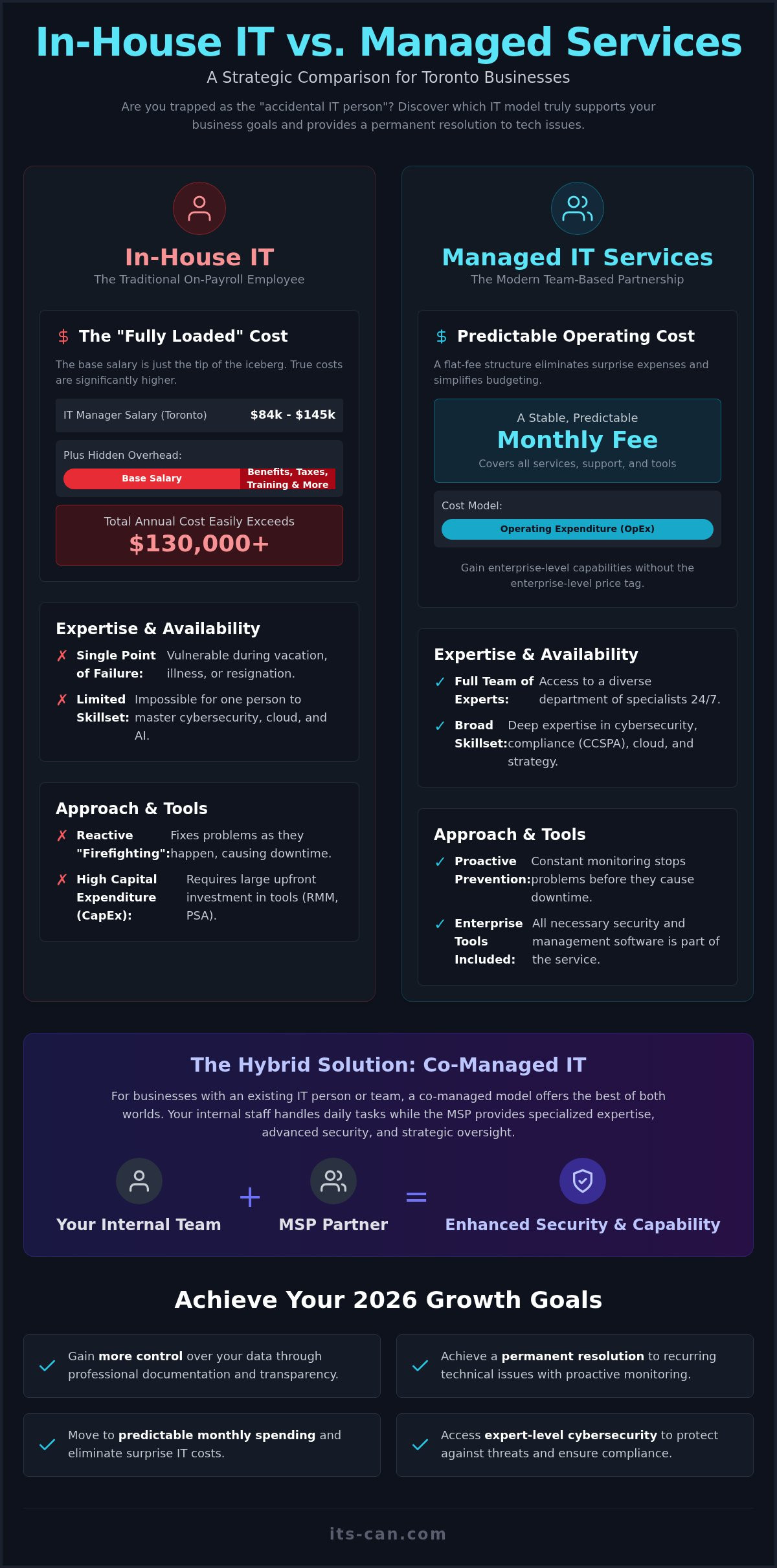
Having a person on-site feels reassuring. They know your staff by name and understand your specific office culture. They can walk over to a desk and fix a physical hardware issue immediately. However, relying on one or two people creates a “single point of failure.” If your IT manager goes on vacation, gets sick, or decides to move to another company, your entire infrastructure is left vulnerable. It is also impossible for one person to master the entire modern tech landscape. No single hire can be an expert in AI advisory, cloud architecture, and 24/7 cybersecurity monitoring all at once.
The Managed Service Provider (MSP) Model
An MSP offers a “Team vs. Individual” advantage. Instead of one person’s limited skill set, you gain access to a full department of experts. Managed IT Services focus on a proactive approach rather than waiting for things to break. This model provides a permanent resolution to technical issues by using constant monitoring to stop problems before they disrupt your staff. They act as a strategic partner, ensuring your technology aligns with your growth goals. By choosing this path, you move away from reactive firefighting and toward a stable, expert-led environment where your team can finally focus on their actual jobs.
The Financial Reality: Sticker Price vs. Total Cost of Ownership
How much does an employee actually cost your company? When comparing in-house IT vs managed services, many Toronto business owners only look at the base salary. In 2026, the average salary for an IT Manager in Toronto ranges from approximately $84,518 to as high as $145,296. While that sticker price is already significant, it is only the beginning of your investment. You have to account for the “fully loaded” cost. This includes benefits, payroll taxes, office space, and the constant need for expensive technical training to keep up with new regulations like the CCSPA. Industry data confirms that a single in-house professional can easily cost over $130,000 annually once these extras are tallied.
Contrast this with a managed services model. Instead of a fluctuating budget filled with surprises, you move to a predictable, flat-fee structure. This allows you to plan your growth without fearing the next big repair bill. You also have to consider the cost of silence. When your systems go down, how much does one hour of lost productivity cost your GTA team? If your only IT person is stuck in traffic or busy on another call, your business sits idle. A managed partner provides the assurance of constant uptime, ensuring that technical glitches never turn into expensive disasters.
Infrastructure and Software Licensing Costs
An internal hire doesn’t arrive with a full toolkit. They need specialized software to do their job effectively. You will likely need to pay for Remote Monitoring and Management (RMM) tools, Professional Services Automation (PSA) platforms, and advanced security stacks. These licenses represent a heavy capital expenditure (CapEx). Managed providers already own these tools and include them as part of their service package. This shifts your technology costs into a manageable operating expenditure (OpEx), giving you enterprise-level tools without the enterprise-level price tag.
Scalability and Growth Flexibility
What happens when your business grows from 20 employees to 40? One IT person who was once “enough” suddenly becomes overwhelmed. Hiring a second person doubles your salary obligations instantly. Managed services offer a more graceful way to scale. You can increase your support levels as your Toronto business expands without the friction of recruiting and onboarding new staff. You also gain 24/7 monitoring and support without ever paying overtime or holiday rates. If you are unsure which financial path fits your five-year plan, a professional technology advisory session can help clarify your options.
Control vs. Capability: Addressing the Biggest SMB Objections
Do you worry that handing over your network to an outside firm means losing the keys to your own kingdom? It’s the most common objection we hear from Toronto business owners. There is a persistent myth that having an employee down the hall equals having more control. In reality, the opposite is often true. Relying on a single person often creates “knowledge silos” where only one individual knows the passwords, configurations, and history of your systems. If that person leaves, you are left in the dark. A managed partner uses professional documentation and transparent reporting to ensure you always have a clear, accessible map of your entire infrastructure.
When you weigh in-house IT vs managed services, you’re really comparing one person’s limited capacity against a collective brain trust. No single hire can realistically master cloud architecture, hardware maintenance, and high-level Cybersecurity Protection all at once. The “Expertise Gap” is real; as technology evolves in 2026, the sheer volume of knowledge required to keep a business safe and efficient has surpassed what one person can provide. By partnering with a team, you gain the capability of an entire department without the management burden of a large internal staff.
Security and Compliance in 2026
The threat landscape has shifted dramatically. Recent data shows that 60% of small businesses are now active targets for ransomware and phishing attacks. While an internal hire might handle basic updates, they often lack the time or specialized tools to perform deep Cybersecurity Assessments. These evaluations are critical for identifying hidden vulnerabilities before hackers find them. With new regulations like Bill C-27 and updated Ontario privacy rules now in full effect, having certified experts manage your compliance is no longer optional; it’s a requirement for survival.
The “Permanent Resolution” Philosophy
Most internal IT roles fall into the “Break-Fix” trap. Something breaks, they fix it, and everyone waits for it to break again. We believe in a different approach. Our goal is the permanent resolution of technical issues by identifying and eliminating the root cause of recurring problems. This proactive mindset is supported by a dedicated Help Desk that provides rapid support to your employees. You gain the reassurance of a partner who takes personal responsibility for your uptime, ensuring your team stays productive instead of waiting for a single, overwhelmed IT person to return their call.
The Co-Managed IT Model: Best of Both Worlds?
Is your internal IT lead spending their entire day fighting fires instead of planning for your future? It’s a stressful position to be in. You want to keep your trusted employee, but you also need the specialized skills of a full department. The co-managed model offers a practical solution. In this setup, your internal expert focuses on high-level strategy and company-specific needs, while the external partner handles the repetitive maintenance and complex security tasks.
When you look at in-house IT vs managed services, it doesn’t have to be an all-or-nothing decision. This hybrid approach prevents burnout by taking the weight of daily support tickets off your employee’s shoulders. It also gives them access to enterprise-level tools they wouldn’t otherwise have. Instead of struggling with basic software, they can use the same advanced systems that large corporations use to monitor and protect their networks. By providing your internal lead with professional monitoring and management platforms, you turn a single worker into a highly efficient manager. They no longer have to manually check every server or track every ticket in a spreadsheet. This professionalization of your IT department is a key benefit of the co-managed model.
When to Consider a Hybrid Approach
Your team might need help if your internal person is consistently overwhelmed by day-to-day tickets. This usually happens when a business scales beyond 50 employees and the volume of support requests grows too large for one person. An MSP can step in to handle specialized projects like Cloud Migrations, which require temporary but intense expertise that your staff might not possess. This partnership also provides 24/7 coverage. When your internal staff goes home for the evening or takes a holiday, your systems remain under constant watch. You get total peace of mind without needing to pay for an around-the-clock internal shift or expensive overtime rates.
Strategic Technology Advisory
A hybrid model moves your business from “keeping the lights on” to using technology as a genuine competitive edge. Through professional IT Consulting, you can align your technical investments with your long-term growth goals. This often includes access to a vCISO (Virtual Chief Information Security Officer). This expert provides the high-level security guidance you need to meet the strict requirements of Bill C-27 and the CCSPA without the cost of a full-time executive hire. They help you build a roadmap that turns technology from a cost center into a growth engine. If you’re ready to see how a hybrid model could work for your team, book a discovery call today to discuss your specific needs.
Choosing the Right Path for Your Business Growth
How much stress does your current technology setup cause you on a weekly basis? If you find yourself constantly worrying about the next system crash or dealing with the same glitches over and over, it’s time for a change. The choice between in-house IT vs managed services is ultimately about how much risk you’re willing to accept. Staying in-house makes sense if your operations are small enough that one person can handle every task without feeling overwhelmed. However, if you require 24/7 vigilance, expert-level cybersecurity, and predictable monthly spending, the managed model is the smarter investment for your 2026 growth goals.
Working with a local Toronto partner is essential for true peace of mind. While remote support is fast, there are times when you simply need “boots on the ground” to handle physical hardware issues or office expansions. We believe in providing a permanent resolution to technical issues so you never have to deal with the same frustrating problem twice. This stability allows you to scale your business with confidence, knowing your infrastructure is being monitored by experts who are personally accountable for your success. It’s time to stop being the “accidental IT person” and start being the leader your company needs.
Checklist: Is Your Business Ready for Managed IT?
- Do you experience recurring technical issues that never seem to go away? If you are fixing the same server error every month, your current support is failing to find the root cause.
- Is your current IT support reactive rather than proactive? Waiting for things to break before fixing them is the most expensive way to manage a business.
- Are you worried about the rising threat of cyberattacks in the GTA? With the average cost of a data breach in Canada rising to CA$6.98 million in 2025, you cannot afford to leave your security to a single hire.
- Are you struggling to keep up with new privacy regulations? Meeting the requirements of Bill C-27 and the CCSPA requires specialized knowledge that most generalists don’t possess.
The ITS Canada Inc Difference
We pride ourselves on being an approachable and respectful partner for Toronto businesses. We promise to communicate in plain English, avoiding the confusing industry jargon that often makes technology feel like a black box. Our team provides rapid response times backed by comprehensive performance guarantees that ensure you’re never left waiting. At ITS Canada Inc, we don’t just act as a service provider; we act as a trusted advisor dedicated to your long-term success. If you are ready to end the cycle of technical frustration and achieve a permanent resolution for your business, Book a Discovery Call today to find your ideal IT solution.
Secure Your Business Success for 2026
Choosing between in-house IT vs managed services is a turning point for your company growth. You’ve seen how the loaded costs of internal hiring and the risks of knowledge silos can hinder your daily operations. Moving toward a professional partnership ensures that your technology finally functions as a stable foundation rather than a source of constant stress. The goal is simple: technology that works so well you forget it’s even there.
Since 2009, we’ve proudly served the GTA with 24/7 proactive monitoring and a no-jargon communication guarantee. We believe you deserve a technology partner that acts as a trusted advisor, not just a repair service. It’s time to invest in a secure and expert-led infrastructure that supports your long-term vision. End your IT frustrations today; schedule a Discovery Call with ITS Canada Inc. We’re ready to help you build a more reliable future.
Frequently Asked Questions
Is managed IT support cheaper than hiring a full-time employee?
Yes, managed services are typically much more cost-effective. A full-time IT manager in Toronto in 2026 has a fully loaded cost exceeding $130,000 annually when you include benefits, taxes, and training. Managed services provide a whole team of experts for a predictable monthly fee that is usually a fraction of a single executive’s salary. You also save money on expensive software licenses and infrastructure tools.
Can I keep my current IT person if I hire a managed service provider?
Absolutely. This is called the co-managed IT model. Your internal staff stays focused on high-level business strategy while the external team handles the heavy lifting of security, 24/7 monitoring, and routine maintenance. It is an excellent way to prevent employee burnout. It also gives your internal lead access to enterprise-grade tools they likely wouldn’t have on their own.
How do managed services improve our cybersecurity compared to in-house IT?
Managed providers offer a specialized team rather than a single generalist. While one person might miss the latest ransomware trends, a provider uses collective intelligence and advanced tools to monitor your network around the clock. This is vital in 2026. The average cost of a Canadian data breach has climbed to CA$6.98 million, making professional oversight a necessity for survival.
What happens if our managed IT provider goes out of business?
You maintain full ownership of your data and systems. A professional provider ensures that all documentation, passwords, and configurations are shared with you transparently through a secure portal. This prevents any knowledge silos from forming. If a provider closes, your documented infrastructure makes it simple to transition to a new partner without losing operational control or your history.
Do managed IT services provide on-site support in Toronto?
Yes, local providers offer “boots on the ground” support when remote fixes aren’t enough. While most issues are resolved instantly through a remote help desk, physical hardware failures or office moves require a technician on-site. When comparing in-house IT vs managed services, choosing a partner that specifically serves the GTA ensures you get rapid, in-person assistance when it matters most.
How quickly can a managed service provider respond to an emergency?
Most providers offer specific response time guarantees in their contracts. For critical emergencies, support often begins within minutes. Because a provider has a full team available, you don’t have to wait for a single employee to finish another task or return from a holiday before your problem gets attention. This speed is essential for maintaining productivity across your team.
Are managed IT services suitable for very small businesses with under 10 employees?
Yes, they are often the most sensible solution for small teams. When you have fewer than 10 employees, hiring a full-time IT person is usually financially impossible. Managed services allow you to access expert-level cybersecurity and support at a scale that fits your current budget. This helps you grow your business without the stress of constant technical setbacks or glitches.
What is the typical contract length for managed IT services in 2026?
Contract lengths typically range from one to three years, though some providers offer flexible month-to-month options. Longer terms often come with price protections that shield you from inflation. When weighing in-house IT vs managed services, look for agreements that include clear performance benchmarks. These benchmarks ensure your partner remains accountable for delivering a permanent resolution to your technical issues.