Are you tired of frustrating tech problems grinding your business to a halt? Does the thought of deciphering a long list of IT acronyms-from MSPs to cybersecurity-leave you feeling overwhelmed and unsure of what your company truly needs? Choosing the right services for it shouldn’t be a guessing game, and you certainly shouldn’t have to fear overpaying for solutions you don’t understand. You just want technology that works, reliably and securely, so you can focus on your customers.
That’s exactly why we created this plain-English guide. We’re cutting through the clutter to give you the clarity you deserve. Here, you’ll finally understand the different types of IT support, identify which services are essential for your business to be secure and efficient, and learn how to choose a reliable partner. It’s time to feel empowered, make confident technology decisions, and put an end to your IT headaches finally and forever.
Key Takeaways
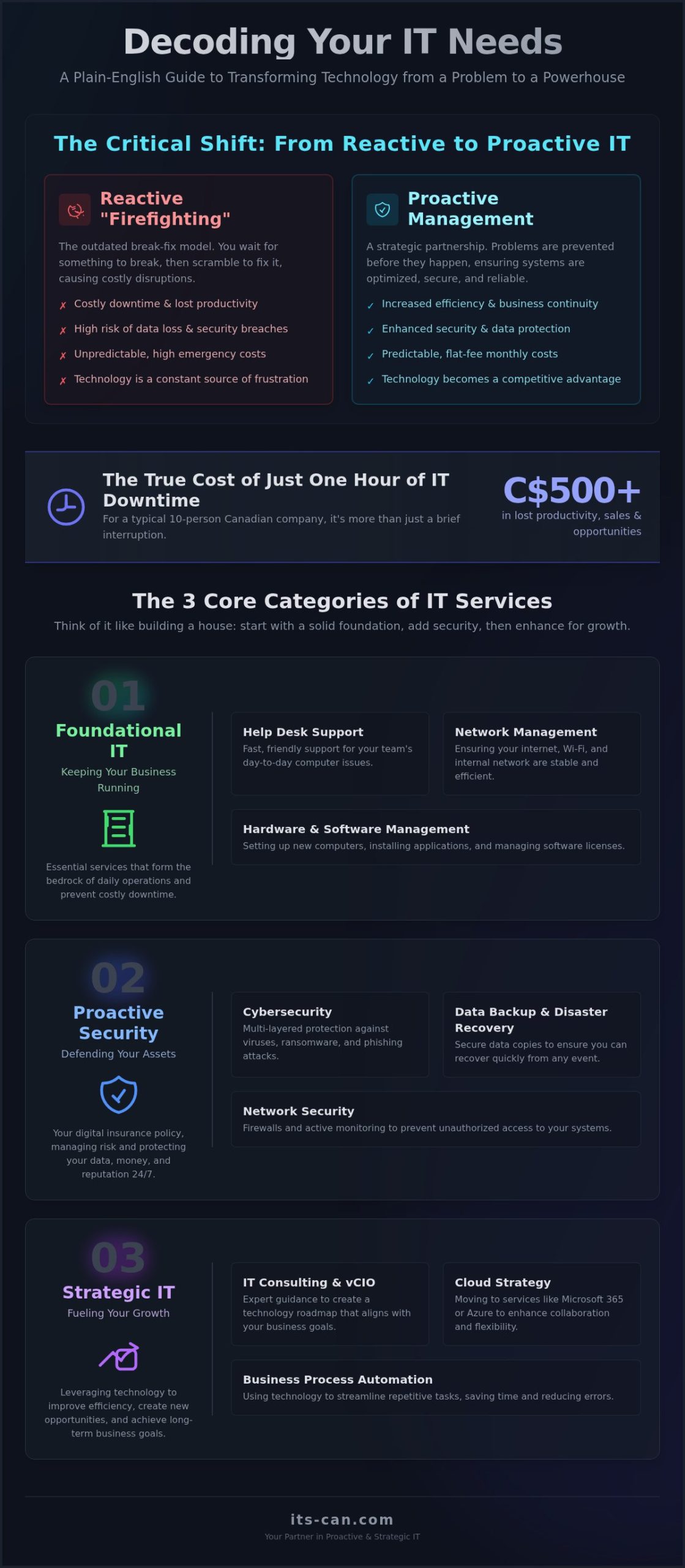
- Shift your IT from a source of frustration to a strategic asset by understanding the difference between reactive “firefighting” and proactive management.
- Not all services for it are the same. Learn to categorize your needs into three simple groups to avoid paying for support you don’t need.
- Discover the four primary delivery models for IT support to find the one that best fits your company’s budget, goals, and growth plans.
- Get a practical checklist of crucial questions to ask any potential IT partner, ensuring you choose a provider who can truly protect your business.
What Are IT Services? (And Why They’re Not Just for Big Corporations)
In plain English, IT services are the professional management of all your business technology. This includes everything from keeping your computers and network running smoothly to protecting your critical data from cyber threats. For too long, business owners have viewed IT as a necessary evil-a frustrating cost centre you only deal with when something breaks.
But that mindset is changing. Modern technology management has shifted from reactive ‘firefighting’ to a proactive strategy. Instead of waiting for a crisis, the goal is to prevent problems before they can disrupt your operations, hurt your sales, or damage your reputation. This approach connects technology directly to your business goals, turning it into a powerful tool for improving efficiency and driving growth. The most common misconception? That only large enterprises need professional services for it. In today’s digital world, that couldn’t be further from the truth.
Beyond the ‘IT Guy’: The Modern Role of Technology in Business
The old break-fix model-calling an ‘IT guy’ only when a server crashes or a laptop dies-is an outdated and expensive gamble. The modern approach is a strategic partnership with a Managed Service Provider (MSP) who works proactively to keep your systems optimized and secure. This transforms IT from a reactive expense into a competitive advantage, enabling you to deliver better customer service, streamline operations, and focus on what you do best: running your business.
The True Cost of ‘Good Enough’ IT
Have you ever calculated what just one hour of downtime truly costs your business? For a typical 10-person Canadian company, the cost can easily exceed C$500 per hour when you factor in lost productivity, sales, and opportunities. Beyond the immediate financial hit, ‘good enough’ IT exposes you to devastating risks:
- Data Loss: A single hardware failure or ransomware attack can wipe out years of critical financial and client data.
- Security Breaches: Weak security makes you an easy target for cybercriminals, leading to financial theft and regulatory fines.
- Reputational Damage: An IT failure that affects your customers can destroy the trust you’ve worked so hard to build.
Investing in professional services for it isn’t just about buying technology; it’s an investment in business continuity, security, and the ultimate peace of mind.
The 3 Core Categories of IT Services for Your Business
Feeling overwhelmed by a long list of tech terms and acronyms? You’re not alone. The sheer number of available services for it can be confusing, making it difficult to know where to start. To cut through the noise, we can group IT services into three simple categories based on what they do for your business.
Think of it like building a house. You need a solid foundation before you can install a security system, and you need both of those before adding smart home upgrades. While technical frameworks exist, like Gartner’s definition of IT Services, this business-focused approach helps you prioritize what matters most. A complete IT strategy addresses all three areas to ensure your technology is stable, secure, and driving growth.
Category 1: Foundational IT (Keeping Your Business Running)
These are the essential, non-negotiable services that form the bedrock of your daily operations. This is the solid foundation of your house-without it, nothing else can be built. The goal here is to eliminate frustrating tech problems and ensure your team has reliable tools to do their jobs, preventing costly downtime.
- Help Desk Support: Fast, friendly support for your team when they run into computer issues.
- Network Management: Ensuring your internet, Wi-Fi, and internal network are stable and efficient.
- Hardware & Software Management: Setting up new computers, installing software, and managing licenses.
Category 2: Proactive Security & Protection (Defending Your Assets)
Once your foundation is solid, the next step is to install a robust security system. This category is focused on managing risk and protecting your most valuable assets: your data, your money, and your reputation. Think of these services as your digital insurance policy, working 24/7 to defend you from cyber threats, human error, and unexpected disasters.
- Cybersecurity: Multi-layered protection against viruses, ransomware, and phishing attacks.
- Data Backup & Disaster Recovery: Creating secure copies of your data so you can recover quickly from any event.
- Network Security: Firewalls and monitoring to prevent unauthorized access to your systems.
Category 3: Strategic IT (Fueling Your Growth)
With a stable foundation and strong security, you can now leverage technology to get ahead. These are the “smart home upgrades” that make your business more efficient, competitive, and profitable. These strategic services for it transform technology from a necessary expense into a powerful engine for achieving your long-term goals.
- IT Consulting (vCIO): Expert guidance to create a technology roadmap that aligns with your business objectives.
- Cloud Solutions: Moving your data and applications to the cloud for better accessibility, collaboration, and scalability.
- Business Process Automation: Using technology to automate repetitive tasks, freeing up your team to focus on high-value work.
Delivery Models: How to Get the IT Services You Need
Understanding what IT services you need is only half the battle. The other half is choosing how those services are delivered. The right model can save you money, prevent frustrating downtime, and align technology with your business goals. The wrong one can lead to spiraling costs and constant headaches. Let’s break down the four common ways Canadian businesses get the expert technology support they need.
In-House IT Staff
This traditional model involves hiring a full-time IT manager or team. They are a dedicated resource who understands your company’s culture and specific needs intimately. However, this comes at a high price-a single IT professional’s salary in Canada can easily top C$90,000, plus benefits and training. You also risk knowledge gaps and having a single point of failure if that person gets sick or leaves.
Best for: Larger companies with complex, proprietary systems that require a constant, on-site presence.
The Break-Fix Model
Just like it sounds, you call for help when something breaks, and you pay a fee for the service call to fix that single issue. While it seems cheap upfront, the costs are unpredictable and often high. The biggest flaw? Your IT provider only makes money when you have problems. Their success is tied to your downtime, creating a clear conflict of interest that no business owner should accept.
Best for: Very small businesses with minimal technology and a high tolerance for risk and unexpected expenses.
Managed IT Services (MSP)
This is the modern, proactive approach to business technology. Instead of waiting for things to break, you partner with a Managed Services Provider (MSP) for a flat, predictable monthly fee. The MSP’s job is to monitor, maintain, and secure your systems 24/7 to prevent problems before they can disrupt your business. This is one of the most effective ways to access comprehensive services for it, as our goals are perfectly aligned: we profit when you stay productive, not when you have a crisis. If you’re wondering exactly what’s covered, our guide on what’s included in an IT service package breaks it down in plain English.
Best for: Small and medium-sized businesses (SMBs) who want to eliminate IT problems, control their budget, and focus on growth.
Co-Managed IT (A Hybrid Approach)
What if you have an IT person on staff but they’re overwhelmed? Co-managed IT is the solution. An external provider works alongside your internal team, supplementing their skills and capacity. We can handle time-consuming tasks like 24/7 monitoring and helpdesk support, or provide specialized expertise for cybersecurity and strategic projects, empowering your in-house staff to focus on high-value initiatives.
Best for: Companies with an IT manager who needs to scale their capabilities without hiring more full-time staff.
Which Model Is Right for You? A Quick Comparison
- In-House: High, fixed cost. Proactive but limited by team’s skillset. Goals are aligned with the company.
- Break-Fix: Unpredictable, hourly cost. Purely reactive. Goals are misaligned (they profit from your pain).
- Managed Services (MSP): Predictable, flat monthly fee. Proactive partnership. Goals are perfectly aligned for uptime.
- Co-Managed IT: Predictable, supplementary fee. Proactive partnership. Enhances and aligns with your internal team.
A Plain-English Glossary of Common IT Services
Navigating the world of IT can feel like learning a new language. To help you make informed decisions, we’ve translated the most common “geek-speak” into plain English. This glossary breaks down the essential services for it that Canadian businesses rely on, focusing on what they actually do for you. Think of this as your quick-reference guide to building a secure and efficient technology foundation.
Foundational Service Definitions
These are the core services that keep your daily operations running smoothly and prevent frustrating interruptions.
- Help Desk Support: Your on-demand team for fixing daily tech issues. When a computer freezes, a password is lost, or software won’t load, our experts are just a call or click away. This means your staff gets fast, friendly help to get back to work without delay.
- Network Monitoring: A 24/7 watch over your systems to detect problems early. We proactively monitor your servers, computers, and network for signs of trouble, often fixing issues before you even know they exist. This is the key to preventing costly downtime.
- Vendor Management: We deal with your internet, software, and other tech providers so you don’t have to. Instead of spending hours on hold with a vendor, you make one call to us, and we take care of the rest, freeing you to focus on your business.
Security Service Definitions
In today’s digital landscape, protecting your company’s data isn’t optional-it’s essential for survival.
- Managed Cybersecurity: A multi-layered defence against modern threats like viruses, ransomware, and phishing scams. This isn’t just antivirus software; it’s a comprehensive strategy that includes firewalls, email filtering, and employee training to keep your business secure.
- Data Backup & Disaster Recovery: Your business continuity plan. We create secure, automated copies of your critical data. If you ever face a server crash, fire, or cyber-attack, we can restore your information and get you back online quickly.
- Penetration Testing: Ethical hackers test your defences to find weaknesses before criminals do. We simulate a real-world cyber-attack to identify vulnerabilities in your network, applications, and procedures, allowing you to fix them proactively.
Strategic Service Definitions
These forward-looking services for it help you leverage technology to grow your business and gain a competitive edge.
- Cloud Services: Moving your servers, applications, and data to secure and reliable platforms like Microsoft 365 or Azure. This provides your team with secure access from anywhere, improves collaboration, and reduces the cost of maintaining on-site hardware.
- IT Consulting (vCIO): High-level strategic advice to align your technology with your business goals. A virtual Chief Information Officer (vCIO) helps you budget for IT, plan for future growth, and ensure your tech investments deliver a real return.
- Custom Web Development: Creating a professional, secure, and user-friendly digital storefront for your business. Your website is often a customer’s first impression-we build sites that not only look great but also drive leads and sales.
Feeling overwhelmed by the options? You don’t have to be. We can help you identify the exact services that will solve your current frustrations and support your future goals. Book a no-obligation consultation today.
How to Choose the Right IT Service Partner in Toronto
Understanding the different types of IT services is the first step. The next, more critical step is choosing the right partner to deliver them. You’re not just hiring a vendor to fix broken computers; you’re selecting a technology partner who will play a key role in your business’s growth and security. The right choice can eliminate IT headaches and unlock new efficiencies, while the wrong one can lead to costly downtime and endless frustration.
To find a true partner, you need to ask the right questions and look for tangible proof of their commitment.
Key Questions to Ask Before You Sign
A truly professional provider will have clear, straightforward answers to these critical questions. Use this checklist to vet any potential provider:
- What is your guaranteed response time when we have a problem? When your system is down, every minute costs you money. Vague answers like “as soon as possible” aren’t good enough. Look for a specific, guaranteed time to ensure your issue is addressed immediately.
- Do you speak in plain English and avoid technical jargon? You shouldn’t need a degree in computer science to understand your IT support. A commitment to “No Geek-Speak” ensures clear communication and a stress-free relationship.
- Are your services proactive, or do you just fix things when they break? Modern services for it should prevent problems, not just react to them. A proactive partner monitors your systems 24/7 to stop issues before they can disrupt your business.
- Do you have experience working with businesses in our industry? Whether you’re in finance, manufacturing, or healthcare, your business has unique technology needs and potential compliance standards. Ensure they have relevant experience.
Look for Proof: Guarantees, Testimonials, and Local Presence
Talk is cheap. A dependable partner will back up their claims with solid proof of their capabilities. Does the provider offer a 100% satisfaction guarantee? This shows they are confident in their service and willing to stand behind their work with real accountability.
Ask for testimonials from other local Toronto businesses-what are your peers saying about their experience? Finally, never underestimate the value of a local team. While many issues can be solved remotely, some problems require an expert on-site. Having a Toronto-based team means faster, more effective resolutions when you need them most, giving you true peace of mind.
See how ITS Canada Inc provides reliable, stress-free IT services.
Your Next Step to Stress-Free IT
Understanding technology doesn’t have to be a source of stress. As this guide has shown, IT services are not a luxury reserved for large corporations-they are a fundamental tool for keeping your business secure, efficient, and competitive. The most critical decision you’ll make is choosing a partner who understands your business goals, not just a technician who speaks in jargon. Finding the right services for it empowers you to focus on growth instead of fighting fires.
At ITS Canada, we’ve been that trusted partner for businesses across Toronto and the GTA since 2009. We believe in delivering peace of mind through action, which is why we guarantee a 1 Minute Average Answer Time and back our work with a 100% No-Hassle Satisfaction Guarantee. No geek-speak, just reliable support that lets you get back to what matters most.
Don’t let frustrating computer problems dictate your day. Ready to end frustrating computer problems? Book a free, no-obligation consultation today.
Frequently Asked Questions About IT Services
What is the difference between IT services and managed IT services?
Traditional IT services are often reactive-you call for help only when something breaks. This “break-fix” model can lead to frustrating downtime and unpredictable costs. Managed IT services, however, are proactive. For a predictable monthly fee, a provider continuously monitors, maintains, and optimizes your systems to prevent problems from happening in the first place. This approach gives you peace of mind and keeps your business running smoothly.
How much should a small business budget for IT services?
In Canada, a small business should typically budget between C$75 and C$250 per employee, per month for comprehensive managed IT services. The final cost depends on your specific needs, such as the number of users, the complexity of your network, and the level of cybersecurity required. Viewing this as an investment in preventing costly downtime and security breaches is key. A good provider will offer a clear, predictable plan with no hidden fees.
What are the first IT services a startup or new business should get?
For a new business, the most critical first services for it are foundational security and reliability. This includes professional email setup (like Microsoft 365), robust cybersecurity protection to guard against threats from day one, and a reliable, automated data backup and recovery solution. Getting these essentials right protects your new venture from data loss and cyberattacks, letting you focus on growth instead of worrying about IT nightmares.
Can I outsource just my cybersecurity or data backup?
Absolutely. Many businesses choose to outsource specific, critical functions. Outsourcing just your cybersecurity or data backup to a specialist is a smart way to gain enterprise-level protection without committing to a full managed IT service package. This ensures your most valuable assets-your data and your reputation-are protected by experts, giving you targeted support where you need it most. It’s a flexible solution to solve a specific, crucial business problem.
How do I know if it’s time to switch IT service providers?
If you’re constantly dealing with recurring IT issues, slow response times, or surprise invoices, it’s a clear sign to look elsewhere. Does your current provider speak in confusing “geek-speak” instead of plain English? Are they reactive, only fixing problems instead of proactively preventing them? A reliable IT partner should be an asset that frees you to run your business, not a source of constant frustration and unpredictable costs.
What does ’24/7/365 monitoring’ actually mean?
In plain English, 24/7/365 monitoring means that automated systems are constantly watching over the health and security of your IT network-every minute of every day, including holidays. These systems look for potential issues, security threats, or performance problems. This proactive approach allows us to detect and fix many problems before they can cause costly downtime for your business, giving you true peace of mind around the clock.