Are you trying to set a budget for your company’s IT support, only to find that every quote you receive is wildly different? When you start researching the managed IT services Toronto cost, it can feel like comparing apples to oranges, leaving you worried about hidden fees and the risk that the cheapest option will lead to costly downtime. It’s a frustrating position for any business owner who simply wants reliable technology without the stressful guesswork.
We’re here to put an end to that confusion, finally and forever. This 2026 pricing guide is designed to give you clarity and confidence. We’ll break down the common pricing models in plain English, explain the key factors that determine your investment, and show you how to evaluate quotes to ensure you get exceptional value. Our goal is simple: to empower you to make a smart, informed decision that gives you peace of mind and lets you get back to focusing on your business.
Key Takeaways
- Learn the difference between per-user, per-device, and tiered pricing models to find a predictable, stress-free IT budget that works for your business.
- The managed IT services Toronto cost isn’t one-size-fits-all; this guide provides realistic 2025 price ranges (in C$) so you can budget effectively and avoid overpaying.
- Pinpoint the key factors-like company size and security requirements-that providers use to calculate your quote, empowering you to have a more informed conversation.
- Shift your focus from a monthly cost to a long-term investment by learning how proactive IT support prevents expensive downtime and protects your bottom line.
Decoding Managed IT Pricing: The 3 Common Models in Toronto
Are you trying to budget for IT support and finding it a frustrating process? You’re not alone. When business owners ask about the managed IT services Toronto cost, they are often surprised to learn there’s no single price tag. The truth is, pricing isn’t like buying a laptop off the shelf; it’s a tailored service designed to solve your specific business challenges, finally and forever.
The right IT partner won’t just give you a number-they’ll help you understand the value behind it. Providers of managed services typically structure their fees in one of three ways. Understanding these models is the first step to finding a plan that gives you predictable costs and complete peace of mind, allowing you to focus on running your business.
The Per-User Model: Simple and Scalable
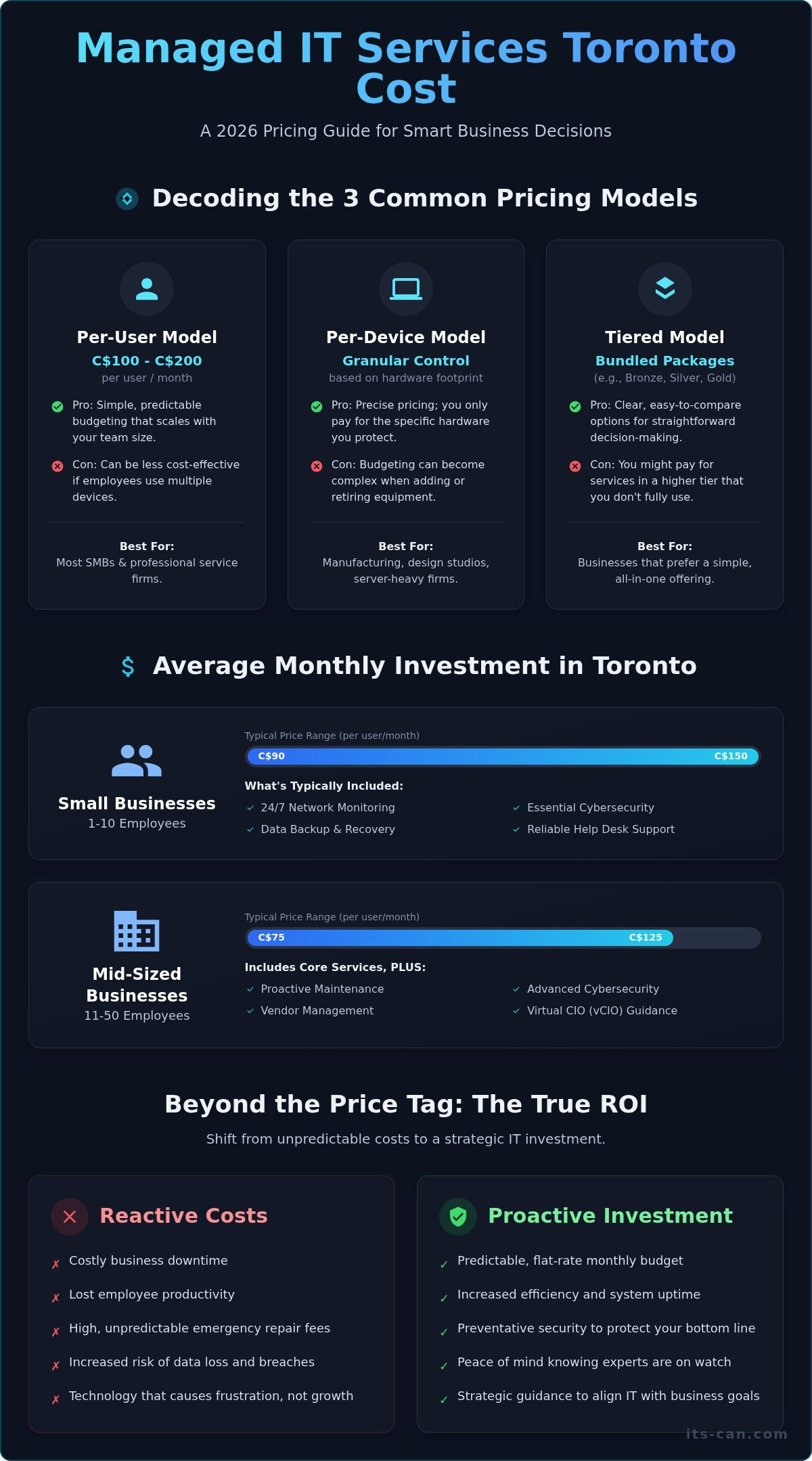
Think of this model like a gym membership for your team. You pay a flat, predictable monthly fee for each employee who needs IT support (e.g., C$100 – C$200 per user). This is the most common approach for a reason.
- Pros: Budgeting is incredibly simple. As your team grows or shrinks, your IT costs scale directly with them.
- Cons: It can become less cost-effective if your employees use multiple devices (desktop, laptop, tablet, phone) that all require support.
- Best For: Most small to mid-sized businesses in Toronto, especially professional services firms where the employee count is the main driver of IT needs.
The Per-Device Model: Granular Control
This approach is like paying for individual parking spots instead of a company-wide pass. You are billed a flat fee for each specific device being managed, whether it’s a server, desktop, laptop, or network switch.
- Pros: The pricing is precise and directly tied to your technology footprint. You only pay for the hardware you want protected.
- Cons: Tracking every device can make budgeting complex, especially when adding or retiring equipment.
- Best For: Businesses with more hardware than people, such as manufacturing facilities, design studios, or companies with extensive on-site server infrastructure.
The Tiered Model: Good, Better, Best Packages
Similar to choosing a cell phone or internet plan, the tiered model bundles services into pre-defined packages (often named Bronze, Silver, Gold). Each tier offers a progressively larger set of services for a fixed monthly price.
- Pros: The options are clear and easy to compare, making the selection process straightforward.
- Cons: You might end up paying for services in a higher tier that you don’t fully use, making it less efficient than other models.
- Best For: Businesses that prefer a simple, all-in-one offering and want to avoid making granular decisions about individual services.
Average Managed IT Services Cost in Toronto: What to Expect
Are you trying to budget for IT support but find the pricing confusing? You’re not alone. The managed IT services Toronto cost can vary widely, but understanding the typical price ranges can help you plan effectively. While the figures below are reliable estimates for 2026, remember that every business is unique. A final quote will always depend on your specific technology, security needs, and growth goals.
The most significant factor influencing cost is your company’s size and complexity. A five-person startup has vastly different IT requirements than a 75-person firm with strict compliance obligations. Here’s a breakdown of what you can expect to invest based on your team’s size.
For Small Businesses (1-10 Employees)
For a small team, the primary goal is often to ensure technology simply works so you can focus on your customers. The focus is on foundational support and security to prevent common, costly problems like downtime or data loss.
- Typical Price Range: C$90 – C$150 per user, per month.
- What’s Usually Included: Core services like 24/7 network monitoring, essential cybersecurity (antivirus, spam filtering), data backup, and reliable help desk support for day-to-day issues.
For Mid-Sized Businesses (11-50 Employees)
As your business grows, your reliance on technology increases, as do the risks. At this stage, IT support shifts from being purely reactive to proactive and strategic. The goal is not just to fix problems, but to optimize systems for better efficiency and security.
- Typical Price Range: C$75 – C$125 per user, per month.
- What’s Usually Included: Everything in the small business plan, plus proactive network maintenance, advanced cybersecurity, vendor management, and strategic guidance from a Virtual CIO (vCIO) to help you make smart technology decisions.
For Larger Businesses (50+ Employees)
Companies of this size often have complex networks, dedicated internal IT staff, and specific regulatory requirements. IT services become a deeply integrated partnership, designed to support sophisticated infrastructure and high-stakes business objectives.
- Typical Price Range: Highly customized based on a detailed assessment.
- What’s Usually Included: A bespoke plan that may include co-managed IT (supporting your in-house team), specialized compliance and governance support (PIPEDA), dedicated engineers, and advanced security operations.
Ultimately, understanding the average managed IT services Toronto cost is the first step. The next is finding a partner who offers a transparent plan that delivers true peace of mind and allows you to put an end to frustrating computer problems-finally and forever.
The 5 Key Factors That Drive Your Final Quote
You won’t find a simple, one-size-fits-all price tag for managed IT services, and for good reason. A generic plan often leads to generic, ineffective support. Instead, a reputable provider will invest time in understanding your business to build a tailored solution that solves your specific challenges. This detailed approach is what truly determines your final managed IT services Toronto cost.
Understanding these key factors will empower you to have a productive conversation with potential IT partners and identify the one that’s truly focused on your success.
1. Number of Users & Devices
This is the most fundamental multiplier in any IT support plan. Each employee with a computer, laptop, or mobile device represents a potential point of support. More users and devices naturally mean a higher likelihood of support tickets, security vulnerabilities, and maintenance needs. Servers are typically priced separately and at a higher rate due to their complexity and critical role in your operations.
2. Required Level of Cybersecurity
This is a major differentiator between a basic, budget plan and a comprehensive, value-driven partnership. A low-cost plan might only include standard antivirus and a firewall. A robust security posture, however, requires advanced solutions like Endpoint Detection and Response (EDR) and proactive threat hunting. If your business must comply with regulations like PIPEDA, the necessary security measures will also influence your investment.
3. Complexity of Your IT Infrastructure
The nature of your technology environment significantly impacts management costs. A straightforward, cloud-only business using Microsoft 365 or Google Workspace is simpler and less expensive to manage. In contrast, a company with on-premise servers, a hybrid cloud environment, or multiple office locations requires far more complex monitoring, maintenance, and support, which is reflected in the price.
4. Service Level Agreement (SLA) & Support Hours
When a critical system fails, how quickly do you need an expert to respond? Standard support plans typically cover 9-to-5 business hours. If your operations run outside of these hours or are too critical to wait, you will need a plan that includes 24/7/365 support. Furthermore, a guaranteed response time is a premium feature that ensures you get help when you need it most, preventing costly downtime. ITS Canada Inc offers a 5-minute response guarantee. See how.
Beyond the Price Tag: What’s Included (and What’s Not)
When evaluating the managed IT services Toronto cost, one of the biggest fears for any business owner is the dreaded hidden fee. A low monthly price can seem attractive, but it often comes with a long list of exclusions that lead to surprise bills. A transparent IT partner will always provide a clear Service Level Agreement (SLA) that details exactly what you’re paying for. This allows you to compare quotes accurately and invest in a service that truly protects your business, rather than just a price tag.
To help you decode any proposal, here’s a straightforward breakdown of what should be included versus what is typically billed as an extra.
Core Services in a Standard Plan
These are the foundational services that keep your business running smoothly and securely day-to-day. A comprehensive plan should always include:
- Unlimited Remote Help Desk Support: Your team gets fast, reliable help for their daily IT issues-like password resets or software glitches-without you worrying about racking up hourly charges.
- Proactive 24/7 Network & Device Monitoring: We watch your systems around the clock to detect and solve problems before they can cause costly downtime. This is the key to preventing IT nightmares.
- Essential Cybersecurity Protection: This includes managed business-grade antivirus, critical software patching, and firewall management to defend your network from common threats.
- Data Backup & Verification: Daily backups of your critical data are essential, but we take it a step further by regularly verifying those backups are successful, giving you true peace of mind.
Common Add-Ons and Project Work (Extra Cost)
While your monthly fee covers daily management, some tasks fall outside this scope. A dependable provider will quote these separately, ensuring no surprises. These often include:
- On-Site Support Visits: While many issues are solved remotely, some problems require a technician on-site. This may be included in premium plans or billed at an hourly rate.
- IT Projects: Major initiatives like an office move, a migration to a cloud platform like Microsoft Azure, or a complete server upgrade are considered projects and are scoped and billed separately.
- Third-Party Software Licensing: Your monthly fee doesn’t typically cover licenses for software like Microsoft 365 or Adobe Creative Suite, though your IT partner will manage them for you.
- Hardware Procurement: The cost of new computers, servers, or networking gear is separate from the management fee. We can handle the procurement to ensure you get the right equipment at a fair price.
Understanding this distinction is the first step toward finding a partner you can trust. At ITS Canada, we believe in complete transparency to help you find a solution that works-finally and forever.
Is It Worth It? The True ROI of Managed IT Services
When business owners analyze the managed IT services Toronto cost, it’s easy to focus on the monthly fee. But that’s the wrong way to look at it. Managed IT isn’t an expense; it’s a strategic investment in your company’s operational stability, cybersecurity, and future growth. The real conversation isn’t about the price you pay, but about the catastrophic costs you proactively prevent.
The Staggering Cost of Downtime
What does a single hour of technology failure truly cost your business? The formula is simple but sobering: (Lost Revenue + Lost Productivity + Reputational Damage). For a typical 15-person Toronto firm, a system-wide outage can easily cost thousands of dollars per hour in stalled work and missed opportunities. Our proactive, 24/7 monitoring is designed to eliminate these issues before they can disrupt your operations, making a predictable monthly fee a small price for complete peace of mind.
Preventing a Devastating Security Breach
In today’s digital landscape, a security breach isn’t a matter of ‘if’ but ‘when’ for unprotected businesses. The average cost of a data breach for a Canadian small business can easily exceed C$100,000 when you factor in regulatory fines, client notification, and legal fees. Managed security is your essential insurance policy. The cost of prevention is a tiny fraction of the astronomical cost of recovery, protecting your finances, your reputation, and your clients’ trust.
Gaining a Strategic Technology Partner
The greatest value of managed IT services isn’t just fixing problems-it’s preventing them and planning for the future. You’re not just hiring a helpdesk; you’re gaining a strategic partner dedicated to your success. Through virtual CIO (vCIO) services, we help align your technology roadmap with your core business goals, ensuring every IT investment drives efficiency and growth. This high-level guidance is invaluable and nearly impossible to replicate with a small internal team. Stop fighting fires. Let’s build your IT strategy together.
Beyond the Numbers: Investing in Your Business’s Future
Navigating IT support in Toronto can feel complex, but understanding the pricing models and key drivers is the first step. As we’ve explored, the final managed IT services Toronto cost is directly linked to your unique needs, from the size of your team to your cybersecurity requirements. The true value, however, isn’t just in the price tag-it’s in the ROI you gain from enhanced security, minimized downtime, and the freedom to focus on growing your business.
If you’re ready to move past unpredictable expenses and confusing tech talk, it’s time for a partner who offers clarity and reliability. At ITS Canada, we provide just that. With our 100% Satisfaction Guarantee, a 5-Minute or Less Response Time, and our promise of No Geek-Speak, Just Plain English Solutions, you get accountable support you can depend on. Stop letting technology frustrations hold you back.
Ready to solve your IT nightmares once and for all? Get a Transparent, No-Obligation Quote for Your Toronto Business today and take the first step towards stress-free IT.
Frequently Asked Questions About Managed IT Services Costs in Toronto
What are the typical setup or onboarding fees for managed IT services?
Setup fees, often called onboarding fees, cover the essential initial work of auditing your current IT environment, installing management software, and documenting your systems. In Toronto, this can range from a one-time charge of C$500 to C$2,500+ depending on your network’s complexity. However, many providers will waive this fee entirely for clients who sign a 12-month or longer agreement, rolling the cost into the ongoing partnership.
Are managed IT services contracts always long-term?
Not anymore. While traditional 1- to 3-year contracts often provide the best monthly pricing, the industry has become more flexible. Many modern, client-focused IT providers in Toronto now offer month-to-month or 90-day agreements. This gives you the freedom to ensure the service is a perfect fit for your business without being locked into a lengthy commitment, offering true accountability and service on your terms.
Is per-user or per-device pricing better for a small business?
The best model depends on how your team works. Per-user pricing is often ideal for small businesses where each employee uses multiple devices (laptop, desktop, smartphone). It simplifies billing and is predictable. Per-device pricing can be more cost-effective if you have shared workstations or more devices than people, such as in a manufacturing or retail setting. A good provider will help you determine the most economical option for your specific needs.
How can I be sure I’m not paying for services I don’t need?
A reputable IT partner will never push a one-size-fits-all package. They should begin with a thorough assessment of your business operations, goals, and existing technology. This allows them to create a customized service plan tailored precisely to your needs. This transparency is key to controlling your managed IT services Toronto cost and ensures you receive maximum value without paying for unnecessary extras, giving you peace of mind.
Does the cost include new hardware or software licenses?
Typically, your monthly fee covers service and support, not the cost of new hardware like computers, servers, or firewalls. Similarly, specialized third-party software licenses (e.g., Microsoft 365, Adobe) are usually billed separately. However, your managed services plan almost always includes essential security software like antivirus and anti-malware. Your provider will also manage procurement to ensure you get the right technology at a fair price.
Why is it better to work with a local Toronto IT provider?
Working with a local Toronto provider offers significant advantages. The most critical is rapid on-site support. When a server crashes or a network goes down, having a technician who can be in your office quickly is invaluable. A local partner also understands the Greater Toronto Area business landscape and can build a stronger, more personal relationship with your team, moving beyond a vendor to become a true technology partner invested in your success.