Your computers are running. Your team is working. And then, without warning, everything stops. For small business owners across the Greater Toronto Area, that moment of technical failure isn’t just an inconvenience; it’s lost revenue, frustrated clients, and a sinking feeling that your technology is always one bad day away from letting you down. Finding reliable IT support for small business GTA owners has never felt more urgent, or more confusing.
You already know the frustration. The recurring problems that never seem to get fully fixed. The fear that a ransomware attack could wipe out everything you’ve built. The unpredictable bills that make budgeting feel impossible. And that nagging sense that serious IT support is only for companies much bigger than yours. You’re not wrong to feel that way, but you’re wrong to think nothing can be done about it.
This guide was written specifically for GTA small business owners who are ready to stop managing chaos and start building a stable, secure technology foundation. You’ll learn what to look for in a local IT partner, how to protect your business from today’s real threats, and how to get predictable, expert support that speaks plain English, not tech jargon.
Key Takeaways
- Reliable IT support for small business GTA owners is no longer a luxury — this guide shows you exactly how to find a local partner who eliminates recurring problems rather than simply patching them.
- The “break-fix” approach is quietly costing your business more than you realize, and switching to a managed IT model delivers predictable costs and far fewer operational disruptions.
- Cybersecurity threats are targeting small businesses at an increasing rate, and you’ll discover the essential protections that build a genuine digital defence around your operations.
- Cloud tools like Microsoft 365 and Azure can level the playing field for GTA small businesses, giving your team the flexibility and collaboration power that larger competitors already rely on.
- Choosing the right IT partner comes down to a clear framework — you’ll learn the specific questions to ask and the red flags to avoid before signing any agreement.
Why Reliable IT Support is the Backbone of GTA Small Businesses
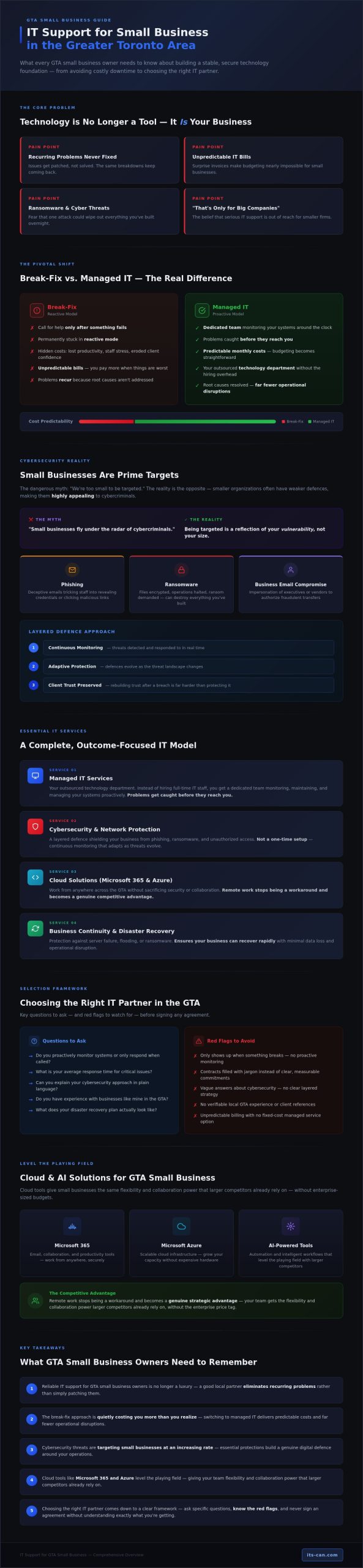
Technology isn’t just a tool your business uses anymore. It is your business. Your client records, your invoicing, your communications, your ability to serve anyone at all — every one of those functions runs on digital infrastructure. When that infrastructure wobbles, everything wobbles with it. For GTA small business owners in 2026, the question isn’t whether you need solid IT support. It’s whether what you currently have is actually delivering it.
Modern IT support for small business GTA owners looks nothing like it did a decade ago. It’s no longer about calling someone when a computer breaks. It’s about having a proactive partner who monitors your systems, catches problems before they surface, and keeps your operations running without interruption. The businesses thriving in the GTA right now aren’t waiting for things to go wrong. They’ve built stability into their foundations.
The High Cost of Downtime in a Fast-Paced City
Toronto’s business environment doesn’t pause for technical difficulties. Your clients expect responsiveness. Your competitors aren’t slowing down. So when your systems go down, even for an hour, the damage compounds quickly. There’s the immediate loss of billable time. Then there’s the ripple effect: delayed deliverables, frustrated staff, and the mental energy spent managing a crisis instead of running your business.
The “break-fix” model, where you call for help only after something fails, keeps you permanently in reactive mode. You’re not just paying for repairs. You’re absorbing the hidden costs of lost productivity, staff stress, and the slow erosion of client confidence. Predictable, proactive support eliminates that cycle entirely. When your technology simply works, your team works better too.
Cybersecurity: No Longer Optional for Small Firms
There’s a dangerous myth that small businesses fly under the radar of cybercriminals. The opposite is true. Smaller organizations often have less sophisticated defences, making them appealing targets. Toronto-area businesses have seen a steady rise in phishing attempts, ransomware incidents, and business email compromise attacks in recent years.
Being targeted isn’t a reflection of your size. It’s a reflection of your vulnerability. And beyond the operational damage, a security breach carries a deeper cost: the trust your clients place in you. Rebuilding that trust after an incident is far harder than protecting it in the first place.
Genuine cybersecurity protection isn’t a one-time setup. It’s an ongoing layer of defence that monitors, adapts, and shields your business continuously. For GTA small businesses, that kind of proactive protection isn’t a luxury. It’s the foundation that everything else is built on.
Essential IT Services That Drive Business Outcomes
Not all IT support is created equal. There’s a meaningful difference between a vendor who shows up when things break and a partner who prevents things from breaking in the first place. For GTA small business owners evaluating their options, understanding what each service category actually delivers, in plain terms, is the starting point for making a smart decision.
Here’s what a complete, outcome-focused IT support model looks like in practice:
- Managed IT Services: Your outsourced technology department. Instead of hiring a full-time IT staff member, you get a dedicated team monitoring, maintaining, and managing your systems proactively. Problems get caught before they reach you.
- Cybersecurity and Network Protection: A layered defence that shields your business from phishing, ransomware, and unauthorized access. This isn’t a one-time setup; it’s continuous monitoring that adapts as threats evolve.
- Cloud Solutions: Tools like Microsoft 365 and Azure give your team the flexibility to work from anywhere across the GTA without sacrificing security or collaboration. Remote work stops being a workaround and becomes a genuine advantage.
- Business Continuity and Disaster Recovery: If a server fails, a flood hits your office, or ransomware encrypts your files, a solid recovery plan means you’re back up and running in hours, not weeks. You don’t lose a day of work, let alone a month of revenue.
Jargon-Free Help Desk Support
Most IT frustrations aren’t catastrophic. They’re the daily friction: a printer that won’t connect, a password that locks you out, software that crashes mid-presentation. A professional help desk service resolves these issues fast, without making you feel like you need a computer science degree to follow along. The metric that actually matters here is first-call resolution: your problem gets fixed in one interaction, not passed between technicians over three days. That’s the standard worth holding any IT partner to.
Strategic IT Consulting and Advisory
Good IT consulting isn’t about recommending the latest technology for its own sake. It’s about understanding where your business is headed and making sure your technology investments support that direction. Think of it as having a virtual CIO who helps you plan hardware replacement cycles before equipment fails, budget accurately for software renewals, and avoid costly decisions made without the full picture. For small businesses competing in a fast-moving market, that kind of strategic foresight is what separates businesses that stay ahead from those constantly playing catch-up.
If you’re evaluating whether your current setup is actually serving your business goals, a discovery conversation is a low-pressure way to find out where the gaps are.
Choosing the Right IT Partner in the GTA: A Selection Framework
Picking an IT provider is one of the most consequential decisions a small business owner makes. Get it right and you gain a technology partner who helps you grow. Get it wrong and you’re locked into a frustrating cycle of broken promises and mounting costs. Here’s a clear, step-by-step framework for evaluating your options before you sign anything.
- Step 1: Audit your current frustrations and technical gaps. Before you speak to a single provider, write down what’s actually going wrong. Recurring outages? Slow response times? Software that doesn’t integrate properly? A concrete list of pain points gives you a benchmark to measure every candidate against, and it immediately separates providers who listen from those who just pitch.
- Step 2: Look for local GTA presence and on-site availability. Remote support handles a lot, but not everything. Ask directly whether a technician can physically reach your location when you need them. A provider with genuine roots in the GTA understands the geography, the connectivity landscape, and the specific pressures of operating in this market.
- Step 3: Evaluate their communication style. If a provider can’t explain what they do in plain English during a sales conversation, they won’t explain it clearly when something goes wrong at 2pm on a Tuesday either. The right partner for IT support for small business GTA owners communicates in outcomes, not acronyms.
- Step 4: Verify security credentials and compliance knowledge. Ask specifically about their experience with Canadian privacy legislation. Vague answers are a red flag.
- Step 5: Demand transparency in pricing and performance guarantees. Monthly costs should be predictable. Ask what’s included, what triggers additional charges, and how performance is measured. If a provider can’t answer clearly, walk away.
The Importance of Local Toronto Expertise
A provider based in the GTA doesn’t just understand your time zone. They understand your environment. Local connectivity issues, building infrastructure quirks, and the specific vendors serving the Toronto market are all things a nearby team encounters regularly. When hardware fails and you need someone on-site fast, proximity matters in a way that a remote-only provider simply can’t replicate.
There’s also a compliance dimension that often gets overlooked. Canadian businesses handling personal information are governed by PIPEDA, Canada’s federal privacy law, and Ontario-specific regulations depending on your sector. A local IT partner who works with GTA businesses daily understands these obligations and can help you structure your data handling, storage, and access controls accordingly. This is a gap that many national or US-based providers leave wide open, and it’s one area where local expertise pays for itself.
Vetting for Cybersecurity Excellence
Ask any IT provider you’re considering to walk you through their security approach. If the answer centres on antivirus software, that’s not enough. Antivirus catches known threats reactively. Managed protection monitors your network continuously, identifies unusual behaviour, and responds before damage spreads. Those are fundamentally different levels of defence.
One of the strongest signals of a serious security partner is whether they proactively recommend a cybersecurity assessment early in the relationship. This process, which includes penetration testing, identifies the actual vulnerabilities in your network before an attacker does. For small business networks, penetration testing often reveals gaps that standard tools never flag. It’s not alarmist; it’s honest. Any provider who skips this conversation isn’t taking your security seriously enough.
If you’re ready to see where your current setup actually stands, a discovery call is the right first step. No pressure, no jargon, just a clear picture of what you’re working with and what’s worth addressing first.
Scaling Your Business with Modern Cloud and AI Solutions
For years, enterprise-grade technology felt out of reach for smaller operations. The hardware was too expensive, the setup too complex, and the ongoing maintenance too demanding. Cloud computing changed that equation entirely. Today, a ten-person firm in Mississauga can access the same calibre of infrastructure that a 500-person corporation relies on, without the capital investment or the dedicated IT department to manage it.
That’s the real promise of cloud adoption: not just convenience, but competitive parity. For businesses evaluating IT support for small business GTA needs, cloud migration is often the single highest-impact move available.
Microsoft 365 and Azure are the clearest examples of this shift in practice. Your team gets professional email, document collaboration, video conferencing, and file storage, all connected, all accessible from any device, anywhere across the GTA. A sales rep working from Markham and an accountant based in Etobicoke can edit the same document simultaneously without emailing files back and forth. That’s not a small efficiency gain. It compounds daily.
AI advisory is the next layer. Small businesses are increasingly using AI-powered tools to automate repetitive tasks, surface insights from client data, and reduce the administrative drag that quietly consumes hours every week. The key is having a technology advisor who helps you identify where AI genuinely fits your workflows, rather than adopting tools for their own sake. Poorly integrated AI creates new problems. Thoughtfully implemented, it gives your team time back.
Modernizing Your Tech Stack
On-premise servers aren’t just outdated; they’re expensive to maintain, vulnerable to physical damage, and a constant source of hidden overhead. Moving to a secure cloud environment reduces that hardware burden significantly. During any migration, performance and security must be maintained without interruption, which is why this transition requires careful planning rather than a rushed cutover. A structured approach means your team barely notices the shift, except that things start working better.
Preparing for Disaster Before It Strikes
Even the best cloud setup needs a recovery plan behind it. The “3-2-1” backup rule is a practical starting point: keep three copies of your data, stored on two different types of media, with one copy held offsite or in the cloud. If ransomware encrypts your files or a server fails, you’re not scrambling. You’re restoring from a clean backup within a predictable window.
Predictable recovery times matter more than most business owners realize. Knowing you’ll be back online within hours, not days, changes how calmly you can respond to an incident. Explore Business Continuity and Disaster Recovery options that give you that certainty before you ever need it.
If you’re unsure whether your current setup could survive a serious disruption, a discovery call is the right place to start that conversation.
The ITS Canada Promise: Ending Your IT Frustrations Permanently
There’s a meaningful difference between an IT provider who manages your problems and one who eliminates them. Managing problems means you still have them, just with someone else involved. Eliminating them means your team stops noticing technology altogether, because it simply works. That distinction is the foundation of everything ITS Canada does for GTA small businesses.
The frustration cycle most business owners describe is remarkably consistent: the same issues resurface, the explanations get more technical each time, and the bills stay unpredictable. That cycle doesn’t end with a better patch. It ends when someone takes personal responsibility for your uptime and treats every recurring problem as a failure worth preventing, not just a ticket worth closing.
That’s the commitment ITS Canada makes. Not to manage your chaos, but to end it.
Why GTA Businesses Choose ITS Canada
Founded in 2009, ITS Canada has spent over fifteen years building a reputation for reliability inside the Toronto business community. That history matters because it represents thousands of problems solved, hundreds of businesses stabilized, and a track record that outlasts any marketing promise. When you’re evaluating IT support for small business GTA owners genuinely depend on, longevity paired with consistent performance is one of the clearest signals you can find.
What sets ITS Canada apart isn’t just experience. It’s accountability. The team puts skin in the game through performance guarantees, meaning your outcomes are measured, tracked, and owned. No vague assurances. No shifting responsibility when things go sideways. If your systems aren’t performing, that’s ITS Canada’s problem to fix, not yours to absorb.
The jargon-free communication promise is equally non-negotiable. Every conversation, from a help desk call to a strategic planning session, happens in plain language. You’ll always know what’s happening, why it matters, and what comes next.
Your Next Steps to Technical Freedom
Starting is simpler than most business owners expect. A Discovery Call is a straightforward, low-pressure conversation designed to give you an honest picture of where your technology currently stands. No sales scripts. No obligation. Just a clear-eyed look at what’s working, what isn’t, and where the real risks are hiding.
From there, ITS Canada builds a roadmap tailored to your specific 2026 business goals. Whether that means shoring up your cybersecurity posture, migrating to a more flexible cloud environment, or simply ending the daily friction your team has quietly learned to live with, the plan fits your business rather than a generic template.
The businesses that stop worrying about technology aren’t lucky. They made one decision: to stop tolerating the frustration and find a partner who takes it personally. That decision starts with a single conversation.
Ready to stop managing the chaos? Book your Discovery Call and take the first step toward a technology foundation that simply works.
Your Technology Foundation Starts With One Conversation
Running a business in the GTA is demanding enough without technology working against you. This guide has walked you through why proactive IT support outperforms reactive fixes, what a complete service model actually looks like, and how to evaluate a local partner who earns your trust rather than just your signature.
The pattern is clear: businesses that stop tolerating technical frustration and build a stable foundation grow with less friction and greater confidence. Finding the right IT support for small business GTA owners isn’t complicated when you know what to look for and what questions to ask.
ITS Canada has been helping GTA businesses do exactly that since 2009. With a local Toronto-based team and a genuine commitment to plain-language communication, the goal is simple: your technology works, and you stop thinking about it.
The next step doesn’t require a big commitment. Book your free IT Discovery Call today and get an honest picture of where your setup stands. A stronger, more secure business is closer than you think.
Frequently Asked Questions About IT Support for Small Business in the GTA
What is the average response time for IT support in the GTA?
Response times vary significantly between providers, so this is one of the first questions worth asking directly before signing any agreement. A quality managed IT provider should be able to tell you exactly what their response time commitments are, broken down by issue severity. A critical system outage warrants a different urgency than a minor software glitch, and any provider worth considering will have clear, documented standards for both.
When evaluating your options, ask specifically about first-call resolution rates, not just initial response. Getting a callback quickly means little if your problem bounces between technicians for three days. Push for specifics, and be cautious of any provider who answers with vague assurances rather than measurable commitments.
Does my small business really need managed IT services?
If your current approach is calling for help only after something breaks, you’re absorbing costs you probably can’t see clearly: lost productivity, staff frustration, and the compounding effect of problems that never get fully resolved. Managed IT services replace that reactive cycle with continuous monitoring and proactive maintenance, so problems get caught before they reach you.
The honest answer is that the right fit depends on how central technology is to your daily operations. If your team can’t serve clients without functioning systems, then yes, a managed approach protects something genuinely critical. A discovery conversation with a provider is a practical way to assess whether your current setup has gaps worth addressing.
How much does IT support for a small business in Toronto cost?
Pricing for IT support for small business GTA owners varies based on the number of users, the complexity of your environment, and the specific services included. Rather than quoting figures that may not reflect your actual situation, the more useful question to ask any provider is what’s included in the monthly fee and what triggers additional charges. Predictable, all-inclusive pricing is one of the clearest advantages of a managed model over unpredictable break-fix bills.
The cost comparison that matters most isn’t managed IT versus nothing. It’s managed IT versus the accumulated cost of downtime, emergency repairs, and the staff hours lost to recurring technical friction. Most business owners find the numbers look quite different once that full picture is on the table.
What is the difference between “break-fix” and managed IT?
Break-fix is exactly what it sounds like: you call someone when something fails, they fix it, and you pay for that visit. There’s no ongoing relationship, no monitoring, and no one watching for problems before they surface. It keeps you permanently in reactive mode, and every bill is a surprise.
Managed IT flips that model entirely. Your provider monitors your systems continuously, handles maintenance proactively, and resolves issues before they become outages. You pay a predictable monthly fee and gain a team that treats your uptime as their responsibility, not just a service call to close.
How do cybersecurity services protect my business from ransomware?
Ransomware protection works in layers, not as a single tool. A serious cybersecurity approach combines continuous network monitoring to detect unusual behaviour, email filtering to block phishing attempts before they reach your inbox, endpoint protection on every device, and a tested backup and recovery plan so that even if an attack succeeds, your data can be restored without paying a ransom.
Antivirus software alone isn’t enough because it only catches known threats. Managed cybersecurity watches for patterns that suggest an attack is underway, even from threats that haven’t been seen before, and responds before damage spreads. The goal is to stop an incident from becoming a crisis.
Can you support my team if we work remotely across the GTA?
Yes, and modern IT support is built for exactly this. Whether your team is split between Mississauga, North York, and a home office in Scarborough, a managed IT provider can monitor every device, deliver help desk support remotely, and ensure your cloud environment keeps everyone connected and secure regardless of location.
The key is making sure your provider has genuine experience with distributed teams, not just remote access as an afterthought. Ask how they handle onboarding a new remote employee, how they secure devices outside the office, and what happens when someone needs hands-on help. Those answers reveal a lot about their actual capability.
Do I need to buy new hardware to switch to a managed IT provider?
Not necessarily. A good provider will assess what you currently have before recommending any purchases. In many cases, existing hardware can be secured, optimized, and managed without immediate replacement. Where hardware is aging or creating risk, a reputable partner will explain the business case clearly rather than pushing unnecessary upgrades.
One of the practical advantages of working with an IT advisor is getting honest guidance on hardware replacement cycles before equipment fails at the worst possible moment. That kind of forward planning prevents emergency purchases and helps you budget accurately, which is far less disruptive than reacting to a server failure mid-week.
What makes ITS Canada different from other Toronto IT companies?
ITS Canada has been working with GTA businesses since 2009, which means the team brings genuine local experience rather than a generic service model applied from a distance. The commitment to jargon-free communication is non-negotiable: every conversation, whether it’s a help desk call or a strategic planning session, happens in plain language that respects your time and doesn’t require a technical background to follow.
Beyond longevity, the difference is accountability. ITS Canada focuses on eliminating recurring problems rather than managing them indefinitely, and the Discovery Call process is designed to give you an honest picture of where your technology stands before any commitment is made. It’s a low-pressure starting point that puts your business needs ahead of a sales agenda.