
Are you tired of waiting hours for IT support, only to face the same frustrating computer glitch again next week? If you’re constantly pulled away from your core business to deal with tech issues, you’ve likely wondered if there’s a better, more reliable solution than the traditional ‘break-fix’ model. For many Canadian businesses, the answer is partnering with a managed service provider.
This proactive approach gives you an entire team of IT experts dedicated to preventing problems before they can disrupt your business-all for a predictable monthly cost. It’s about gaining peace of mind and the freedom to focus on what you do best. In this plain English guide, we’ll cut through the jargon to show you exactly what an MSP does, the specific problems they solve for businesses like yours, and how to decide if this partnership is the key to ending your IT headaches, finally and forever.
Key Takeaways
- Understand the crucial difference between reactive “break-fix” support and a proactive IT strategy that prevents costly downtime.
- Compare the true costs and strategic benefits of outsourcing your IT versus hiring a full-time, in-house team.
- Use our simple checklist to determine if recurring tech frustrations and security worries mean it’s time to hire a managed service provider.
- Learn what critical questions to ask to find a reliable IT partner who can guarantee fast, effective support and give you total peace of mind.
What is an MSP? Moving Beyond ‘Break-Fix’ IT Support
In plain English, a managed service provider (MSP) is an expert IT partner that proactively manages your business technology for a predictable, flat monthly fee. Think of it like a comprehensive wellness plan for your company’s entire IT infrastructure, designed to keep it healthy and prevent problems before they start. This is a world away from the traditional IT support model most businesses are unfortunately familiar with: the costly ’emergency room’ visit every time a computer crashes.
The ‘Break-Fix’ Nightmare: Why Reactive IT Fails
For years, the standard approach to IT was ‘break-fix.’ When a server went down or a laptop failed, you’d call a technician, they’d fix the immediate issue, and you’d get a surprise bill. This model creates a fundamental conflict of interest: the IT company profits from your pain. More downtime and more problems mean more billable hours for them, leaving you with unpredictable costs in Canadian dollars (C$) and frustrating interruptions that grind your business to a halt.
The MSP Model: A Proactive Partnership for Your Business
A managed service provider flips that broken model on its head. Instead of profiting from your failures, our success is directly tied to your stability. We work as your strategic partner, focusing on 24/7 monitoring, security, and optimization to prevent issues from ever happening. This proactive approach, often defined as Managed services, shifts the focus from reactive repair to long-term health, ensuring your technology actively supports your business goals and gives you complete peace of mind.
At a Glance: Break-Fix vs. Managed Services
| Feature | Break-Fix Model | Managed Services Model |
|---|---|---|
| Cost Structure | Unpredictable (Hourly Rate + Parts) | Predictable (Flat Monthly Fee) |
| Core Goal | React to and fix problems | Prevent problems and ensure uptime |
| Business Impact | Costly downtime and budget surprises | Minimized downtime and stable budget |
| Service Approach | Reactive: Waits for you to call | Proactive: 24/7 monitoring and maintenance |
What Services Does a Managed Service Provider Actually Offer?
Many business owners mistakenly believe an IT provider just fixes computers when they break. A true managed service provider (MSP) offers a comprehensive partnership designed to handle your entire technology infrastructure, proactively and strategically. It’s not about selling you a single service; it’s about delivering an all-in-one technology solution that lets you focus on your business. The goal is to move your company from a reactive “break-fix” model to a proactive one where problems are prevented. As outlined in TechTarget’s guide to MSPs, this model encompasses a wide range of essential functions.
24/7 Proactive Monitoring and Maintenance
Imagine having a dedicated team watching over your systems around the clock. That’s the core of proactive support. We monitor your networks, servers, and workstations 24/7/365 to detect and resolve issues before they can cause disruptions. This includes critical tasks like security patch management and system updates to keep everything running smoothly. The business benefit is simple: potential problems are fixed before you or your team even know they exist, eliminating frustrating and costly downtime.
Help Desk and End-User Support
When your employees run into a tech issue, they need fast, effective help. A key service from any managed service provider is a responsive help desk. Whether it’s a password reset, a software glitch, or trouble connecting to a printer, our team is available via phone, email, or chat to provide support. This immediate access to expert help ensures your staff can get back to their work quickly, maintaining productivity across your entire organization.
Cybersecurity and Network Protection
In today’s digital world, a single threat can cripple a business. We provide multi-layered security to protect your most valuable asset: your data. This includes essential services like managed firewalls, enterprise-grade antivirus, email security filtering, and continuous threat monitoring. We also believe in empowering your team through security awareness training. The result is invaluable peace of mind, knowing your business is protected from cybercriminals.
Backup, Disaster Recovery, and Business Continuity
Having a simple backup is not enough. What happens if your office experiences a fire, flood, or a devastating ransomware attack? A comprehensive business continuity plan ensures your data is not only backed up securely but can also be recovered quickly. We design and manage a robust strategy to get your operations back online with minimal delay. This means your business can survive a disaster and continue serving your customers, no matter what.
The Business Case: MSP vs. Hiring In-House IT
For many small and midsize business owners, the question isn’t if they need IT support, but how to get it. The choice often comes down to hiring an in-house IT manager or partnering with a managed service provider. While hiring a dedicated employee seems like a direct solution, a closer look at the costs, expertise, and strategic impact reveals a clear financial and operational advantage to outsourcing.
Cost-Effectiveness: Predictable Budgeting vs. a Full-Time Salary
Hiring a single, experienced IT professional in Canada can cost C$70,000 to C$90,000+ in salary alone. When you add the hidden costs-benefits, CPP/EI contributions, vacation pay, training, and equipment-that single hire can easily exceed C$100,000 per year. In contrast, partnering with an MSP provides comprehensive support for a predictable, flat monthly fee that is often a fraction of that cost. This transforms your IT from a volatile capital expense into a stable, manageable operating expense, giving you complete peace of mind over your budget.
Access to Expertise: A Team of Specialists vs. One Generalist
No single person can be an expert in everything. An in-house generalist may be great at day-to-day fixes but will inevitably have knowledge gaps in critical areas like advanced cybersecurity, cloud architecture, or industry-specific compliance. When you engage a managed service provider, you gain immediate access to an entire team of certified specialists. You get a cybersecurity analyst, a network engineer, a cloud expert, and a helpdesk technician all working to protect and optimize your business technology.
Scalability and Strategic Focus
Your business is not static, and your IT support shouldn’t be either. An MSP allows your technology services to scale up or down seamlessly as your company grows or your needs change-without the slow and costly process of hiring or firing. More importantly, outsourcing your IT frees you and your leadership team from distracting technical fires. Instead of worrying about server downtime or data backups, you can dedicate your time and energy to what truly matters. Let us handle the tech, so you can focus on running your business.
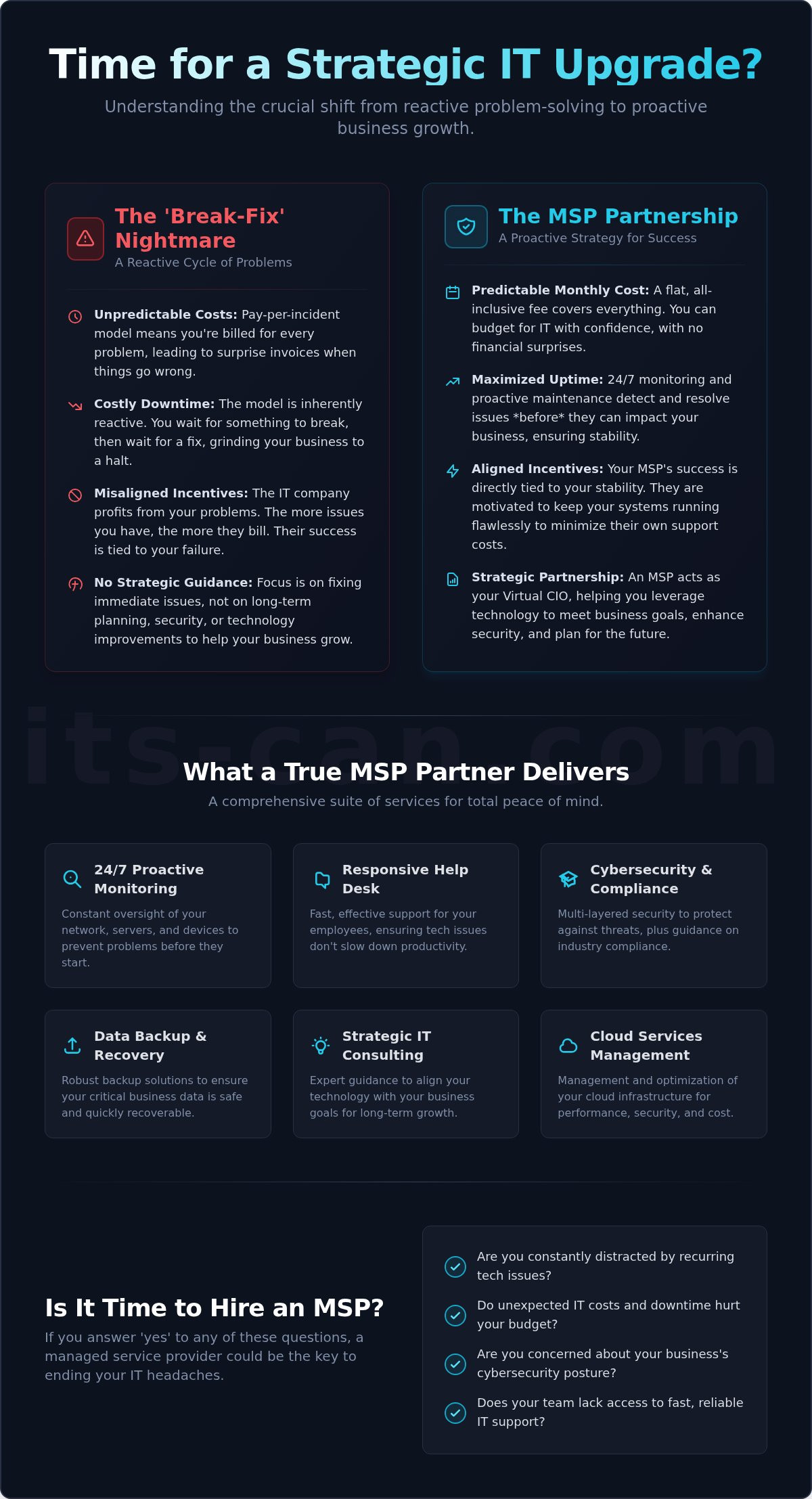
When Is It Time to Hire a Managed Service Provider? (A Checklist)
Most business owners feel the sting of technology problems, but it can be difficult to know when those frustrations have crossed the line from minor annoyance to a major business risk. If you find yourself nodding along to the scenarios below, it’s a clear signal that your current IT approach is holding you back. This checklist is designed to help you self-diagnose the need for a change.
Your Current IT Support Is Unresponsive
When technology fails, every minute of downtime costs you money and momentum. Waiting for support shouldn’t be part of the problem. Ask yourself:
- Are you waiting hours or even days for a callback on critical IT issues?
- Does your current IT “guy” or small team seem overwhelmed and unable to keep up?
- Do recurring problems never seem to get resolved finally and forever?
If so, you’ve likely outgrown your support model. A professional managed service provider is built to deliver fast, reliable support every time.
You’re Worried About Cybersecurity
In today’s landscape, hoping for the best is not a security strategy. A single breach can be devastating. Consider this:
- Do you have a clear, tested plan to recover from a ransomware attack or data breach?
- Are you confident your business is compliant with Canadian data regulations like PIPEDA?
- Do you lack the dedicated expertise to defend against increasingly sophisticated cyber threats?
An MSP provides the expert oversight and advanced tools needed to protect your business, your data, and your reputation.
Your Business Is Growing
Growth should be exciting, not stressful. If your technology can’t keep up, it quickly becomes a bottleneck instead of an asset. Is this you?
- Are you adding new employees, software, or locations, and finding that IT is a constant headache?
- Is your team’s productivity suffering due to slow systems or inadequate tools?
- Does technology feel like it’s creating more problems than it solves?
A true IT partner provides the strategic guidance needed to ensure your technology scales seamlessly with your success.
You Have No IT Strategy
Running your technology in a purely reactive “break-fix” mode is one of the most expensive ways to manage IT. A strategic approach aligns technology with your core business objectives. Ask yourself:
- Do you only think about IT when something breaks?
- Do you lack a technology roadmap that supports your business goals for the next 1-3 years?
- Are you making expensive tech decisions without expert guidance?
An MSP acts as your virtual CIO (vCIO), providing the proactive roadmap you need to make smart, cost-effective technology investments. If these points sound painfully familiar, it’s time to explore how a dedicated IT partner can give you back your peace of mind.
How to Choose the Right MSP Partner for Your Toronto Business
Understanding the benefits of an MSP is the first step. Now, the crucial part: finding the right technology partner for your Toronto-based business. Not all providers are created equal, and asking the right questions will help you separate the true partners from the simple vendors. This ensures you get the reliable, stress-free IT support your company deserves.
Use these key criteria to evaluate a potential managed service provider and make an informed decision.
Ask About Their Response Times and Guarantees
When an IT problem brings your operations to a halt, every minute counts. Don’t settle for vague promises. Ask potential partners for their guaranteed response time, which should be clearly defined in a Service Level Agreement (SLA). A confident provider will also stand behind their work with a 100% satisfaction guarantee. This isn’t just a marketing gimmick; it’s a commitment to accountability and your peace of mind.
Verify Their Local Presence and Expertise
Does the MSP understand the unique challenges and opportunities of the Toronto and GTA business landscape? A local team can provide critical on-site support when a remote fix isn’t enough. Before signing a contract, check for client testimonials and case studies from other local businesses. This confirms they have a proven track record of delivering results for companies just like yours, right here in our community.
Ensure They Speak Your Language (No Geek-Speak)
The best technology partners communicate clearly and respectfully. During your initial consultation, pay attention to their language. Do they explain complex issues in plain English, or do they hide behind confusing technical jargon? A great partner focuses on your business outcomes-like improved productivity, reduced risk, and better efficiency-not just the underlying technology. You should feel empowered by the conversation, not intimidated.
Evaluate Their Security-First Approach
In today’s digital world, cybersecurity cannot be an afterthought. A proactive MSP builds security into every layer of their service, rather than just reacting after a breach occurs. Ask them to detail their security strategy. What essential security tools, 24/7 monitoring, and employee training processes are standard in their service package? Your chosen partner must be vigilant in protecting your data, your employees, and your reputation from ever-evolving threats.
Ready to End Your IT Headaches for Good?
Navigating the world of IT support doesn’t have to be complicated. The key takeaway is that a true technology partner moves your business beyond the reactive, unpredictable “break-fix” model. A proactive managed service provider acts as an extension of your team, focusing on preventing problems, optimizing performance, and securing your data so you can focus on what matters most: running your business.
If you’re a Toronto & GTA business ready to experience what stress-free, reliable IT feels like, we invite you to take the next step. Serving our community since 2009, ITS Canada Inc is committed to your success with a 100% Satisfaction Guarantee and an industry-leading Average 1-Minute Help Desk Answer Time. Let us solve your IT nightmares once and for all. Book a free, no-obligation IT consultation to discover if our proactive approach is right for you.
Frequently Asked Questions About Managed IT Services
How much do managed IT services typically cost?
In Canada, managed IT services are typically priced on a per-user or per-device basis. You can expect to see costs ranging from C$75 to C$250 per user, per month. This predictable flat fee often replaces the high, unpredictable costs of emergency break-fix IT support. This investment covers proactive monitoring, security, help desk support, and strategic guidance, providing far more value and peace of mind than simply reacting to problems after they cause costly downtime.
What is the difference between an MSP and an MSSP (Managed Security Service Provider)?
Think of it this way: a Managed Service Provider (MSP) is your overall IT department, handling everything from network performance and user support to data backups. They manage your entire technology infrastructure. An MSSP, on the other hand, is a specialist focused exclusively on cybersecurity. They provide advanced services like 24/7 threat monitoring, intrusion detection, and incident response. While many MSPs offer strong security, an MSSP provides a deeper, dedicated layer of protection.
Are managed services only for large companies, or can small businesses benefit?
Managed services are incredibly beneficial for small and medium-sized businesses (SMBs). In fact, SMBs often see the greatest return. An MSP provides access to enterprise-grade tools, expertise, and 24/7 support at a predictable monthly cost-a fraction of what it would take to hire a full-time internal IT team. This levels the playing field, allowing smaller companies to prevent costly downtime, improve security, and focus their resources on growing the business, not fighting tech fires.
What is an SLA (Service Level Agreement) and why is it important?
An SLA, or Service Level Agreement, is a critical part of your contract with an MSP. It’s a written guarantee that defines the specific level of service you will receive, explained in plain English. It sets clear, measurable expectations for things like response times for critical issues, network uptime guarantees (e.g., 99.9%), and how performance will be reported. This document ensures accountability and makes sure you are getting the reliable, prompt service you are paying for.
Will I lose control of my IT if I hire an MSP?
This is a common concern, but the answer is no. A true partnership with an MSP means you gain more control, not less. You set the overall business strategy, budget, and goals for your technology. Your MSP acts as your strategic partner and expert technician, handling the complex, day-to-day management to achieve those goals. This frees you from technical headaches, allowing you to focus on high-level decisions and running your business, with complete visibility into your IT performance.
How long does it take to switch to a new managed service provider?
A smooth and professional transition to a new managed service provider typically takes between 30 and 90 days. This process involves a thorough discovery phase to audit your current systems, followed by a strategic onboarding plan. The new provider will then deploy their monitoring and security tools with minimal disruption. A well-managed handover ensures that all your data, accounts, and systems are transferred securely, leading to a seamless start with your new IT partner.