Is your team’s productivity constantly interrupted by frustrating computer problems? From password resets to software that won’t cooperate, these small issues quickly add up to hours of wasted time and mounting frustration. When you finally get a hold of support, are you met with long delays or confusing tech jargon that doesn’t actually solve the problem? For many Canadian businesses, this cycle of tech-related downtime is a costly and preventable nightmare that you don’t have to accept.
This is where professional help desk it services transform your daily operations. It’s about more than just fixing what’s broken; it’s about providing a fast, reliable, and expert single point of contact for every tech issue. In this guide, we’ll show you exactly what to expect from a top-tier service. You will discover how the right IT partner eliminates daily tech headaches, boosts your team’s productivity, and provides the invaluable peace of mind you need to focus on running your business-finally and forever.
Key Takeaways
- Understand how a help desk acts as a central hub to resolve tech issues fast, preventing minor glitches from disrupting your entire workday.
- Discover the common, productivity-killing frustrations-like login problems and software errors-that a professional help desk eliminates for your team.
- Learn how professional help desk it services translate directly into less downtime, improved employee focus, and a stronger bottom line for your business.
- See how the right IT support delivers the peace of mind you need to stop worrying about technology and focus on serving your customers.
What is a Help Desk IT Service? (Beyond a Simple Fix-It Line)
Are you tired of tapping the shoulder of your most tech-savvy employee every time a printer jams or an application crashes? This “accidental IT guy” approach is a common, yet costly, stopgap. A professional help desk it service replaces this chaos with a single, reliable point of contact for every technology issue your team faces. Its primary goal is simple but crucial: to restore normal service for your employees as quickly as possible, minimizing frustrating downtime and keeping your business moving forward.
Think of it as the central nervous system for your company’s technology. More than just a number to call when something breaks, a modern help desk acts as the frontline for a proactive IT strategy. While Wikipedia’s definition of a help desk focuses on information and support, today’s services are designed to not only solve immediate problems but also to identify patterns that can prevent future issues from happening in the first place.
Help Desk vs. Service Desk: A Plain English Explanation
In the IT world, you might hear these terms used interchangeably, but there’s a key difference. A traditional Help Desk is reactive; it focuses on incident resolution-fixing things that are broken. A Service Desk is broader, handling service requests like setting up a new user or granting software access. At ITS Canada Inc, we eliminate the confusion by blending both, providing a comprehensive support solution that handles every IT need, from urgent fixes to strategic requests.
Core Components of a Professional Help Desk
A professional service is built on a foundation of proven tools and processes that ensure nothing gets missed. Key components include:
- A Ticketing System: This ensures every request is logged, assigned, and tracked through to resolution. It provides total transparency and accountability, so you always know the status of your issue.
- Multiple Support Channels: Your team gets help on their terms, whether it’s via a direct phone call, a quick email, or our dedicated client portal for easy ticket management.
- A Centralized Knowledge Base: We document your unique IT environment and common solutions, allowing for faster resolutions and empowering your staff with self-help resources for minor issues.
Why ‘Break-Fix’ IT Support Is a Risky Bet for Your Business
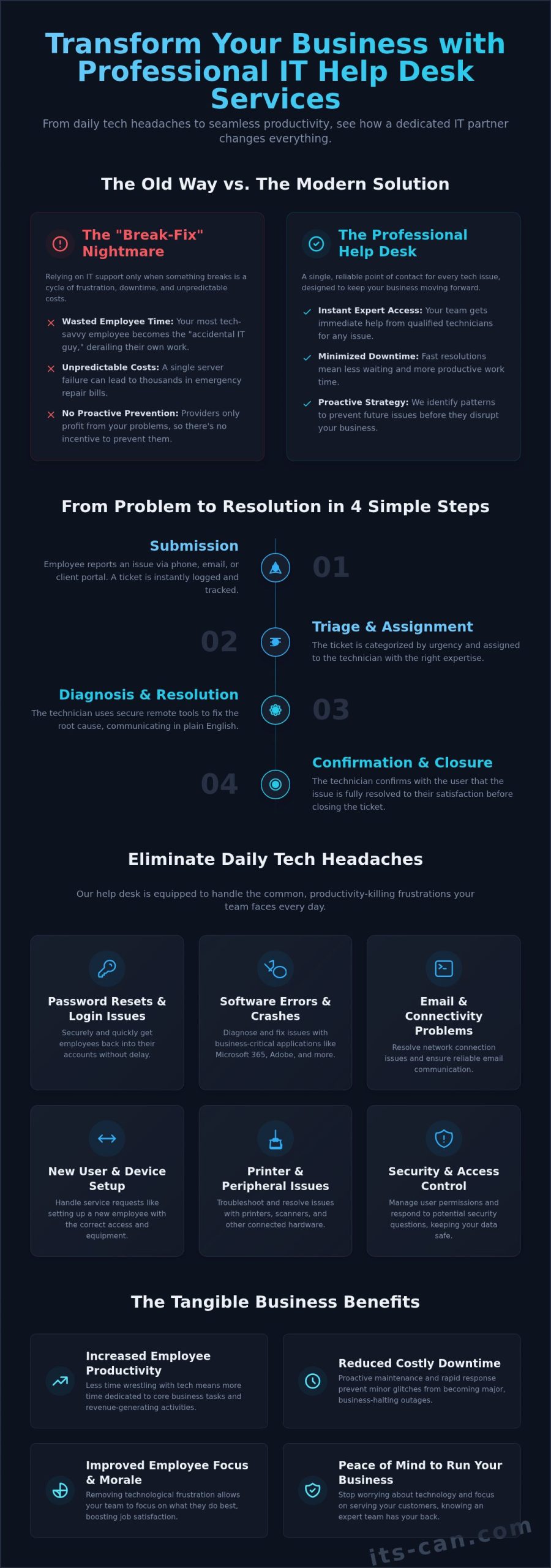
Relying on a break-fix IT model-where you only call for help when something is already broken-is like driving without insurance. The provider only profits from your pain, creating a fundamental conflict of interest. This approach leads to unpredictable costs that can spike into thousands of Canadian dollars with a single server failure. Worse, there is zero incentive for the provider to perform the proactive maintenance that would have prevented the problem, leaving your business vulnerable to the next inevitable crisis.
How an Outsourced IT Help Desk Works in Practice
Ever had that sinking feeling when a critical application freezes right before a deadline? For many employees, this means lost productivity and mounting frustration. But when you partner with professional help desk it services, this scenario changes completely. Instead of searching for a solution, your employee simply contacts the help desk.
Immediately, a support ticket is created with a unique reference number, establishing a clear line of accountability. A qualified technician is assigned and, using secure remote access tools, can view the employee’s screen to diagnose and resolve the problem in real-time. This entire process is designed to be seamless, stress-free, and incredibly efficient, getting your team back to work without delay.
The Lifecycle of a Support Ticket: From Problem to Resolution
Every IT issue follows a structured, transparent path to ensure nothing is ever missed. This predictable process provides peace of mind and guarantees a consistent, high-quality service experience.
- Submission: An employee reports an issue via a quick phone call, email, or a dedicated client portal. The request is instantly logged.
- Triage and Assignment: The ticket is categorized based on its urgency and assigned to the technician with the right expertise to solve it quickly.
- Diagnosis and Resolution: The technician communicates with the user in plain English, remotely accesses the system if needed, and works to fix the root cause of the problem.
- Confirmation and Closure: Before closing the ticket, the technician confirms with the user that the issue is fully resolved to their satisfaction.
Understanding Service Level Agreements (SLAs)
A Service Level Agreement (SLA) isn’t just a policy; it’s a guaranteed promise. It contractually defines the response and resolution times you can expect. For example, an SLA might promise a “1-minute average phone answer time” or a “15-minute response for critical, system-down issues.” This commitment is about more than just fast fixes; it’s a cornerstone of improving employee experience and minimizing costly business downtime.
Remote Support vs. On-Site Dispatch
The vast majority of IT issues-typically 80-90%-can be diagnosed and solved remotely, saving you time and money. This includes problems like software glitches, password resets, and network access issues. However, some problems require a hands-on approach. An on-site technician is dispatched for physical tasks like hardware failures, new equipment installation, or complex network wiring issues. This is why choosing a local provider is so critical; it ensures that when you do need someone on-site, you get a rapid, effective response.
Common Problems Solved by Help Desk IT Services
Are constant IT interruptions slowing your team down? A professional help desk it services provider like ITS Canada Inc acts as your first line of defense, tackling the daily technical frustrations that drain productivity and morale. Instead of your staff trying to play tech support, they can get immediate, expert help to solve their IT nightmares once and for all. This allows your team to stay focused on what they do best: serving your customers and growing your business.
Here are the common, time-consuming issues a reliable help desk eliminates from your workday.
Everyday User Issues and Application Support
These are the frequent, frustrating glitches that can bring an employee’s workflow to a complete halt. A help desk provides immediate relief for problems like:
- Password Resets and Account Lockouts: Instantly get employees back into their critical accounts without delay.
- Microsoft 365 Troubleshooting: Fixing issues with Outlook, Teams, Word, or Excel that prevent work from getting done.
- Printer and Scanner Problems: Resolving the dreaded “printer offline” message or scanner connection failures that disrupt document workflows.
- Application Errors: Quickly diagnosing why essential business software is crashing, freezing, or running slow.
Hardware, Network, and Connectivity Troubleshooting
When the tools themselves fail, your business stops. Quality help desk it services are essential for diagnosing and resolving core infrastructure problems, ensuring your team stays connected and operational.
- Slow Computer Performance: Identifying the root cause of a sluggish computer, from malware to failing hardware.
- Network and Wi-Fi Issues: Restoring dropped connections to shared drives, servers, and the internet.
- VPN Access for Remote Staff: Ensuring your team in Canada and beyond can connect securely and reliably from any location.
- Hardware Repair Coordination: Managing warranty claims and repairs for laptops, desktops, and other devices, saving you the headache.
User Account Management and Security
Properly managing who has access to what is critical for security and efficiency. A help desk handles these vital administrative tasks promptly and securely.
- New Employee Onboarding: Setting up new hires with all necessary accounts, software, and permissions so they are productive from day one.
- Departing Employee Offboarding: Immediately revoking all access to protect your sensitive company data when an employee leaves.
- Permission Management: Adjusting access rights to shared folders and applications to ensure data integrity and security.
The Business Benefits: How a Help Desk Boosts Your Bottom Line
Beyond fixing error messages and password resets, professional IT support is a strategic investment that delivers a measurable return. When you stop looking at IT as a cost centre and start seeing it as a tool for efficiency and growth, the value becomes crystal clear. A dedicated help desk doesn’t just solve problems; it eliminates the costly distractions that prevent you from focusing on what matters most: running your business.
Increase Employee Productivity and Reduce Downtime
What is the real cost of an IT problem? Consider this: if an employee earning C$35 per hour spends just 30 minutes trying to fix an issue, that’s C$17.50 in lost wages. Now multiply that across your team and the year. With a dedicated help desk, resolutions are fast and efficient. Instead of searching for answers, your team has a single, reliable point of contact, allowing them to get back to revenue-generating work and eliminating frustrating downtime.
Gain Predictable IT Costs and Control Your Budget
Are you tired of surprise invoices for emergency IT support? The old “break-fix” model means you only pay when something goes wrong-often resulting in a shockingly high bill. Professional help desk it services move you to a predictable, fixed monthly fee. This transforms your IT spending from a volatile, reactive expense into a stable, manageable operating cost. You can budget with confidence and gain the peace of mind that comes from knowing your support is covered, no matter what.
Improve Security and Access a Team of Experts
A single in-house IT person can’t know everything. A help desk gives you access to the collective knowledge of an entire team of certified experts. This team sees and solves hundreds of unique issues across various industries, ensuring you benefit from a vast pool of experience. More importantly, they enforce consistent security protocols for every user and device, proactively protecting your business from evolving cyber threats and giving you enterprise-level expertise without the enterprise-level cost. For a deeper understanding of how technology can work for your business rather than against it, explore our comprehensive guide to IT support services for small businesses.
Ultimately, a help desk service is about taking back control. It’s about empowering your team to be productive, securing your valuable data, and making your technology work for you, not against you. Ready to stop wasting time on IT issues and start focusing on growth? Book a free consultation.
Your Partner in Proactive, Stress-Free IT Support
As we’ve seen, a modern IT help desk is far more than a reactive fix-it line; it’s a strategic partner dedicated to optimizing your operations. By proactively resolving issues and preventing costly downtime, the right help desk it services directly contribute to your productivity and, ultimately, your bottom line. It’s about transforming technology from a source of frustration into a powerful tool for growth.
Instead of waiting on hold or dealing with confusing tech jargon, imagine getting an expert on the phone in under a minute. At ITS Canada, we’ve been providing that level of responsive, reliable support to businesses across Toronto and the GTA since 2009. We’re so confident in our ability to solve your IT nightmares that we back our service with a 100% ‘No-Hassle’ Satisfaction Guarantee.
Ready to put an end to frustrating computer problems finally and forever? Book a free, no-obligation consultation today. Let’s give you the peace of mind to focus on what you do best: running your business.
Frequently Asked Questions About Help Desk IT Services
What is the difference between help desk services and managed IT services?
Think of it this way: help desk services are primarily reactive, focused on solving immediate end-user problems like password resets or software glitches. It’s the essential support your team needs to fix issues as they arise. Managed IT services are proactive and all-encompassing. They include the help desk but also add 24/7 network monitoring, cybersecurity, strategic planning, and preventative maintenance to stop problems before they can cause costly downtime for your business. To learn more about the full spectrum of technology solutions available to Canadian businesses, read our ultimate guide to IT support services for small businesses.
How much do help desk IT services typically cost for a small business?
For a small business in Canada, costs are typically structured on a per-user or per-device basis, providing a predictable monthly expense. You can generally expect to invest between C$40 to C$80 per user each month. This price can vary based on the level of support required, such as 24/7 availability versus standard business hours. Investing in professional help desk IT services eliminates the stress and high costs of unexpected IT failures, giving you peace of mind.
Is our business too small to benefit from an outsourced help desk?
Absolutely not. No business is too small to suffer from the frustration and lost productivity caused by IT problems. In fact, smaller businesses often see the greatest benefit. Instead of pulling you or your staff away from revenue-generating work to troubleshoot tech issues, an outsourced help desk provides enterprise-level expertise at a fraction of the cost of hiring an in-house technician. It allows your team to stay focused on what they do best: serving your customers.
What kind of response times can we expect for our support requests?
Response times should be clearly defined in a Service Level Agreement (SLA). For a high-priority issue that stops your business from functioning, you should expect an immediate response-often in 5 minutes or less. For less urgent requests, a response within an hour is a common standard. A reliable provider will not only respond quickly to acknowledge the ticket but will also have clear targets for resolving the issue, ensuring your team gets back to work as fast as possible.
How do you provide support to our remote or work-from-home employees?
We provide seamless support to your remote team, no matter where they are in Canada. Using secure, state-of-the-art remote access tools, our technicians can troubleshoot issues directly on your employees’ computers with their permission. It’s just like having an IT expert sitting right beside them. We can resolve software problems, configure VPN access, and ensure they have secure, reliable connections to your business systems, keeping your entire team productive and protected.
What happens if an issue cannot be resolved remotely?
While the vast majority of IT issues can be solved remotely, we are always prepared for situations that require a hands-on approach. If a problem like a hardware failure cannot be fixed over the phone or via remote access, we will dispatch a qualified technician to your office for on-site support. We manage the entire process from start to finish, ensuring the problem is resolved completely and letting you get back to running your business without worry.