Is your team constantly battling slow computers, frustrating error messages, and disruptive downtime? If you’re a business owner in Canada, these tech headaches don’t just cause stress-they cost you money and productivity. You know you need professional help, but the world of IT support can feel overwhelming. When you hear the term it service, it’s easy to get lost in a sea of confusing acronyms and technical jargon, leaving you unsure of what you’re actually paying for.
We believe you deserve clarity and peace of mind. This guide is your straightforward, no-geek-speak roadmap. We will break down exactly what’s included in a typical IT service package, from proactive network monitoring and cybersecurity protection to reliable day-to-day support. By the end, you’ll understand your options and feel confident asking the right questions, so you can find the right partner to end your frustrating computer problems, finally and forever. If you’re looking for a broader overview, our plain-English guide to services for IT is a great place to start.
Key Takeaways
- Modern IT support goes beyond just fixing what’s broken; it includes essential daily maintenance to prevent costly downtime and keep your team working smoothly.
- Protecting your business requires more than just basic antivirus. A comprehensive package layers multiple security services to safeguard your sensitive data and reputation.
- The right it service provider acts as a strategic partner, helping you use technology not just to solve issues, but to actively drive business growth.
- Understanding the difference between reactive (break-fix) and proactive (managed) support models is key to choosing a partner that fits your business needs and budget.
Foundational IT Services: Keeping Your Business Running Smoothly
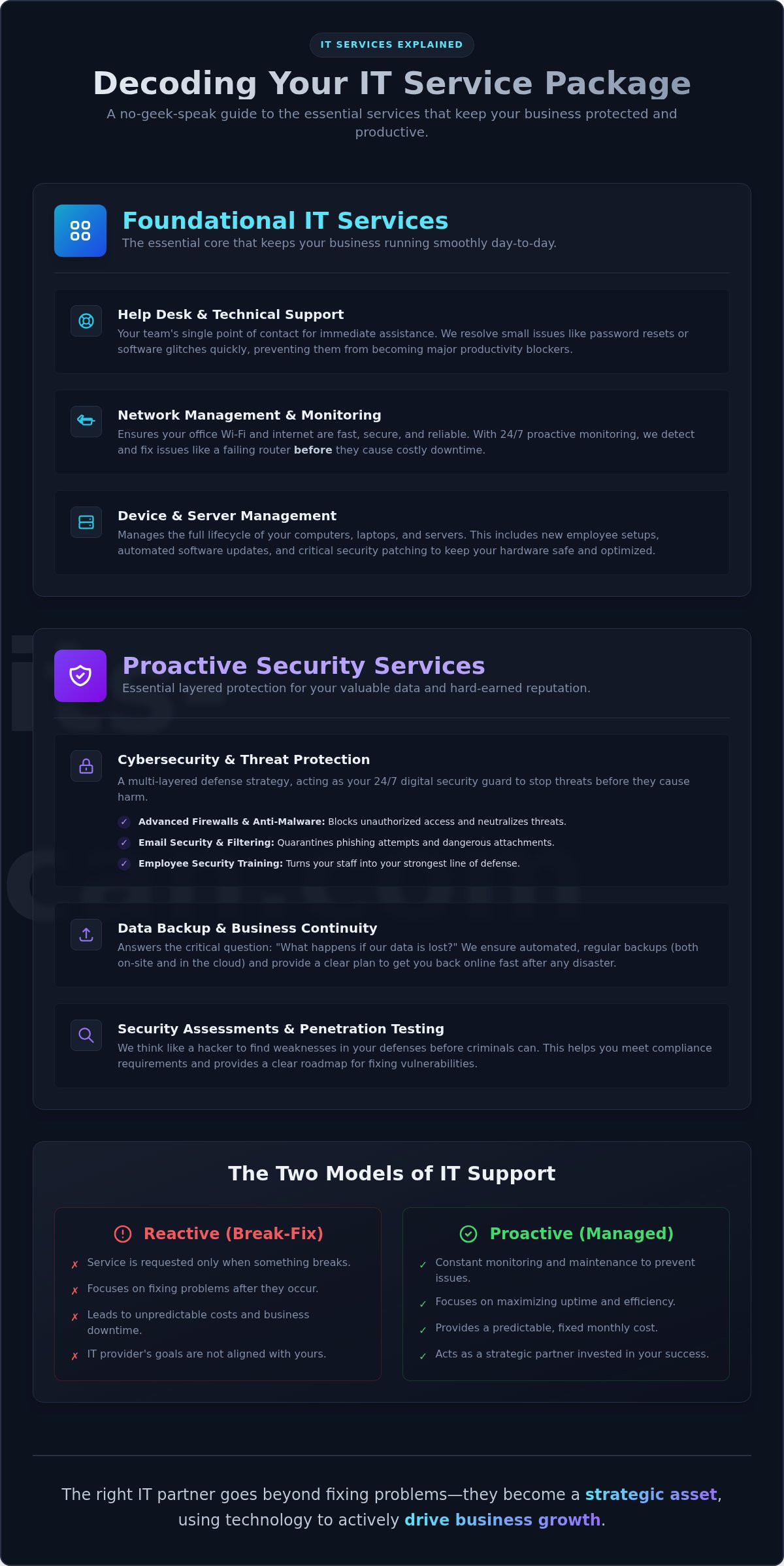
Think of foundational IT services as the essential plumbing for your office technology. You don’t always see them, but when something goes wrong, your business can grind to a halt. These are the core, day-to-day services designed to keep your team working without interruption, focusing on troubleshooting, system maintenance, and proactive support. The entire approach is part of a professional discipline known as IT service management (ITSM), which aims to deliver consistent, high-quality technology that empowers your business. The ultimate goal is to eliminate frustrating tech problems, maximize uptime, and boost employee productivity.
Help Desk & Technical Support
Frustrating tech glitches can stop a productive day in its tracks. A core component of any standard it service package is a responsive help desk. This provides your employees with a single, reliable point of contact for immediate assistance with issues like password resets or software problems. With both remote and on-site support options, the goal is to resolve these small issues quickly, preventing them from becoming major productivity blockers for your entire team.
Network Management & Monitoring
Your network is the backbone of your business, connecting your team to the tools and data they need. This service ensures your office Wi-Fi and internet are fast, secure, and reliable. Through proactive, 24/7 monitoring, potential problems like a failing router or a security threat are often detected and fixed before they can cause costly downtime. It covers everything from managing critical hardware to securely connecting multiple office locations or remote workers to your company network.
Device & Server Management
From the laptop on your desk to the servers in your back office, every piece of hardware needs to be managed and secured. This foundational service handles the complete lifecycle of your company’s computers, laptops, and servers. This includes setting up new employee equipment, automating critical software updates and security patches to protect against threats, and ensuring your servers are running at peak performance. It’s about keeping your tools safe, updated, and ready for work so your team can focus on their jobs.
Proactive Security Services: Protecting Your Data and Reputation
In today’s digital world, cybersecurity is no longer an optional add-on; it’s an essential part of keeping your business alive. A single data breach can lead to devastating financial loss, crippling downtime, and irreversible damage to your hard-earned reputation. That’s why any comprehensive it service package moves beyond basic antivirus software to provide layered, proactive protection. The goal isn’t just to react to problems-it’s to prevent them from happening in the first place, giving you the peace of mind to focus on running your business.
Cybersecurity & Threat Protection
Think of this as your 24/7 digital security guard. A proactive approach to threat protection establishes multiple lines of defense to stop cybercriminals before they can cause harm. This isn’t a single product, but a combination of tools and strategies working together to keep you safe. Key components include:
- Advanced Firewalls & Anti-Malware: State-of-the-art software that blocks unauthorized access and neutralizes malicious threats.
- Email Security & Filtering: Automatically quarantines phishing attempts, spam, and dangerous attachments before they reach your team’s inboxes.
- Employee Security Training: Equipping your staff to recognize and avoid common scams, turning your biggest potential vulnerability into your strongest defense.
Data Backup & Business Continuity
What would happen if your server failed or your data was encrypted by ransomware tomorrow? A solid backup and business continuity plan is your answer. This service ensures automated, regular backups of all your critical files and systems. By storing copies both on-site for fast recovery and securely in the cloud for disaster-proofing, we ensure your data is always retrievable. More importantly, it includes a clear, actionable plan to get your operations back online quickly, minimizing costly downtime.
Security Assessments & Penetration Testing
The best way to secure your network is to think like a hacker. Security assessments and penetration tests do just that-ethically trying to find weaknesses in your defenses before criminals can exploit them. This process helps you meet the strict compliance requirements of many Canadian industries and demonstrates due diligence in protecting client data. Following standards set by a leading IT industry organization, these tests provide a detailed report on vulnerabilities and a clear roadmap for fixing them, ensuring your defenses are robust and reliable.
Strategic IT Services: Using Technology for Business Growth
A proactive IT service goes far beyond simply fixing what’s broken. It’s about transforming technology from a frustrating cost centre into a powerful engine for business growth. These strategic services are designed to align your technology with your core business objectives, helping you plan for the future, boost efficiency, and gain a real competitive advantage. This strategic approach, a core principle of IT Service Management (ITSM), ensures every technology decision supports your long-term vision. Your IT partner steps into the role of a virtual Chief Information Officer (vCIO), providing the high-level guidance you need to make smart, future-proof decisions.
Cloud Solutions & Migration
Is your office still cluttered with aging, expensive server hardware? Modern IT solutions move your critical infrastructure to the cloud. Migrating to platforms like Microsoft 365 not only frees up physical space but also provides your team with secure access to their work from anywhere, enabling flexible remote work and collaboration without compromising security.
- Secure remote access: Empower your team to work efficiently and safely from any location.
- Reduced hardware costs: Eliminate the need for expensive server upgrades and maintenance cycles.
- Scalable performance: Cloud resources can easily grow or shrink right alongside your business needs.
IT Consulting & Technology Roadmaps
How do you know if you’re investing in the right technology? Without a plan, IT spending can feel like guesswork. Your vCIO provides the expert guidance needed to create a clear technology roadmap. This long-term plan outlines necessary upgrades, software implementations, and security enhancements, ensuring your IT budget is used effectively to support your future goals and prevent costly surprises.
- Strategic budgeting: Make informed decisions on technology investments that deliver real value.
- Long-term planning: A 3-5 year roadmap that aligns technology with your business objectives.
- Expert guidance: Get unbiased advice on the best hardware and software for your specific needs.
Vendor Management
Tired of spending hours on hold with your internet or software provider? A key part of a comprehensive IT service package is vendor management. We handle those frustrating calls for you. Because we speak their technical language, we can diagnose issues and get them resolved much faster, freeing you to focus on what you do best: running your business.
- Saves you time: We sit on hold so you and your team don’t have to.
- Faster resolutions: We speak the “geek-speak” to get to the root of the problem quickly.
- One point of contact: All your technology issues are handled through one trusted partner for total peace of mind.
How Are IT Service Packages Structured and Priced?
Understanding how an IT provider structures their packages is crucial because it reveals their core philosophy. Are they there to simply fix what’s broken, or are they a strategic partner invested in preventing problems in the first place? The industry has seen a major shift, moving away from a model that profits from your pain towards one that succeeds only when you do.
The goal of a modern it service package is to give your business predictable costs and unparalleled peace of mind, freeing you from the stress of unexpected tech failures and invoices.
The Old Way: Break-Fix Support
This reactive model is simple: when something breaks, you call for help and get a bill for the time and materials used. The fundamental problem? The IT provider’s revenue is directly tied to your downtime and frustration. This creates unpredictable costs and leaves your business vulnerable, waiting for the next crisis to happen. For any modern Canadian business, this approach is outdated and simply too risky.
The Modern Way: Managed IT Services
The modern approach is a proactive partnership. With Managed IT Services, you pay a flat, predictable monthly fee (in C$) to a Managed Service Provider (MSP). This fee covers monitoring, maintenance, security, and unlimited support. Because the price is fixed, the MSP is now financially incentivized to keep your systems running smoothly to minimize their own work. Their success is finally aligned with yours.
What Influences the Cost?
While every business is unique, the monthly investment in a managed IT service package is typically based on a few key factors. This ensures you only pay for what you actually need.
- Team and Device Count: The primary factor is the number of employees (users) and computers, servers, and network devices we are protecting and supporting.
- Network Complexity: A single office with a simple server is less complex to manage than a business with multiple locations, cloud infrastructure, and remote workers.
- Security and Compliance Needs: Businesses that handle sensitive data or operate in regulated industries often require advanced cybersecurity and compliance services.
- Service Level Agreement (SLA): Your agreement will define guaranteed response times. A plan that guarantees a 5-minute response will differ from one with a 4-hour commitment.
By moving to a managed model, you trade volatile, reactive repair bills for a stable, predictable operational expense. It’s an investment that allows you to budget effectively and focus on what matters most: running your business. If you’re ready to put an end to frustrating IT problems, we can help you build a plan that fits.
Finding the Right IT Service Partner for Your Business
Choosing a provider for your business technology isn’t just about finding someone with technical skills; it’s about finding a true partner. The right it service provider moves beyond simply fixing what’s broken. They take the time to understand your company’s goals, challenges, and workflow, becoming a seamless extension of your team dedicated to helping you succeed. To better understand the full range of services for IT that modern businesses rely on, it helps to review what a complete support package looks like before you start comparing providers.
When you find a partner who speaks your language and focuses on your business outcomes, you can finally stop worrying about technology and get back to focusing on your customers and growth.
Key Questions to Ask a Potential Provider
To cut through the sales pitches and find a provider you can trust, you need to ask the right questions. Before you sign any contract, be sure to get clear, direct answers to the following:
- What is your average response time for critical issues? When your system is down, every minute costs you money. A reliable partner should be able to guarantee a rapid response time, in writing, to minimize costly downtime.
- Can you provide references from clients in my industry? Experience with businesses like yours in the Canadian market demonstrates an understanding of your specific challenges and compliance needs.
- How do you communicate? Do you promise ‘no geek-speak’? You deserve clear answers in plain English, not confusing technical jargon. A great partner prioritizes transparent communication.
- What kind of satisfaction guarantee do you offer? A confident provider will stand behind their work with a 100% satisfaction guarantee, giving you the ultimate peace of mind and ensuring accountability.
Why Local Support Matters
In a world of remote work, having a local IT partner provides a significant advantage. While many issues can be resolved remotely, some problems require a hands-on approach. A local team can provide fast, on-site support when a server fails or a network issue cripples your office, getting you back online quickly.
More importantly, a local provider understands the unique landscape of your business community because they are part of it. They are invested in the same local economy and are committed to seeing their neighbours thrive. This shared commitment builds a stronger, more reliable partnership.
Tired of frustrating computer problems? Let’s talk.
Your Next Step to Stress-Free, Strategic IT
Choosing an IT provider is about more than just fixing what’s broken; it’s about investing in a partner dedicated to your company’s stability, security, and growth. As you’ve seen, a comprehensive package bundles foundational support to keep you running, proactive security to keep you safe, and strategic guidance to help you scale. The key is finding a plan that aligns perfectly with your business goals, not just a generic checklist of services.
When you find the right partner, you get more than just technical help-you get peace of mind. Imagine an it service where your calls are answered in about a minute and every conversation is in plain English, thanks to our No Geek-Speak Promise. We’re so confident we can eliminate your tech frustrations that we back our work with a 100% Satisfaction Guarantee.
Stop letting technology dictate your day. It’s time to make it work for you.
Ready to end frustrating IT problems forever? Book a free consultation.
Frequently Asked Questions
What is the difference between IT services and managed IT services?
Traditional IT services are often “break-fix”-you call for help when something is already broken, leading to unexpected costs and downtime. Managed IT services are proactive. For a predictable monthly fee, a provider continuously monitors and maintains your systems to prevent problems before they start. This approach keeps your business running smoothly and helps you budget for your technology needs, giving you peace of mind and eliminating frustrating surprises.
How much should a small business expect to pay for IT services?
In Canada, small businesses can expect to pay between C$60 and C$150 per user, per month for a comprehensive managed it service plan. The final cost depends on factors like the number of employees, the complexity of your network, and the level of security and support required. This flat-rate model provides budget predictability and is often more cost-effective than hiring in-house staff or paying for emergency break-fix support, which can lead to unpredictable invoices.
Do I still need IT services if my business primarily uses cloud software?
Absolutely. While cloud software like Microsoft 365 or Google Workspace is powerful, it doesn’t manage itself. You still need professional IT support for critical tasks like ensuring proper security configurations, managing user access, integrating different cloud apps, and providing help when issues arise. A dedicated IT partner ensures your cloud tools are optimized, secure, and working together to help your business grow, rather than creating new headaches for your team.
What is an SLA (Service Level Agreement) and why is it important?
An SLA, or Service Level Agreement, is a straightforward contract that defines the level of service you can expect from your IT provider. In plain English, it’s our written promise to you. It outlines crucial details like our guaranteed response times for issues, network uptime promises, and how we will perform our duties. An SLA is vital because it provides transparency and holds your provider accountable, ensuring you get the reliable, high-quality support your business deserves.
Our business is very small. At what point do we need professional IT services?
The need for professional IT services isn’t about company size; it’s about the cost of disruption. If a single hour of downtime would cost you sales or damage your reputation, it’s time. Other signs include recurring tech issues that distract you from your core business, or growing concerns about cybersecurity threats like ransomware. Proactive IT support prevents these problems, allowing you to focus on your customers and growth, no matter how small your team is.
Can an external IT service provider be as responsive as an in-house employee?
A great external provider can be even more responsive. An in-house employee can be sick, on vacation, or overwhelmed with requests. A dedicated IT partner provides a full team of experts, meaning someone is always available to help. With clear Service Level Agreements (SLAs) guaranteeing response times-often within minutes-you get faster, more reliable support. This team-based approach ensures your IT problems are addressed immediately, without the limitations of a single staff member.